Blog

  • Hello world!

    Welcome to WordPress. This is your first post. Edit or delete it, then start writing!

  • Opportunity to Get Paid $100,000 to Relocate to the USA via the Construction Visa Program

    What if you could pack your tools, your skills, and your ambitions — and trade them for a six-figure salary in the United States of America? For thousands of construction workers, electricians, plumbers, welders, and project managers around the world, this is not a fantasy. It is happening right now through the USA construction visa program. The American construction industry is in the grip of a historic labour shortage, with over 500,000 unfilled positions as of early 2026 according to the Associated Builders and Contractors (ABC). Employers are actively recruiting internationally, offering visa sponsorship, relocation packages, and salaries that exceed $100,000 per year for skilled tradespeople. This guide is your definitive, step-by-step roadmap to understanding exactly how to relocate to the USA from Nigeria — or from anywhere in the world — through the construction visa program, and how to position yourself to earn what your skills are truly worth.

    Is the $100,000 USA Construction Salary Real? The Numbers Speak for Themselves

    Scepticism is healthy. So let us begin with hard data on construction jobs in USA salary ranges before we get into visa programs. The Bureau of Labor Statistics (BLS) and industry surveys paint a compelling picture of the earning potential for skilled construction workers in 2026:

    • Electricians: Median annual salary $61,590 — top 10% earn $100,000+. Union electricians in California, New York, and Texas regularly exceed $120,000 with overtime.
    • Plumbers and Pipefitters: Median $61,550 — experienced plumbers in high-cost cities earn $90,000–$130,000 annually.
    • Construction Managers: Median $104,900 — the 50th percentile of this occupation already exceeds $100,000. Senior project managers at major contractors earn $150,000–$200,000+.
    • Structural Iron and Steel Workers: Median $59,560 — union workers in major metro areas with overtime regularly earn $90,000–$115,000.
    • Elevator Installers and Repairers: Median $97,860 — one of the highest-paid construction trades; experienced workers routinely earn over $120,000.
    • Boilermakers: Median $66,920 — with overtime and union contracts, many earn $95,000–$110,000.
    • Welders (Specialised/Underwater): Median $47,010 for general welding — but specialised pipeline and underwater welders earn $100,000–$300,000+, placing them among the highest-paid tradespeople on the planet.
    • HVAC Technicians: Median $57,300 — experienced HVAC specialists in commercial sectors earn $80,000–$110,000.

    Beyond base salaries, USA construction jobs typically come with comprehensive benefits packages: health insurance (covering the worker and their family), dental and vision insurance, 401(k) retirement plans with employer matching, paid time off, overtime pay (1.5× base rate for hours above 40/week), and in many cases, a housing or relocation allowance for internationally recruited workers. When you factor in all compensation, the total package value often reaches $120,000–$160,000 per year for experienced tradespeople.

    The USA is also in the middle of a historic infrastructure spending wave. The Bipartisan Infrastructure Law passed in 2021 allocated $1.2 trillion for roads, bridges, broadband, clean energy, and water infrastructure — a spending programme that is actively creating demand for skilled construction labour through 2030 and beyond. The construction labour shortage is structural, not temporary, which is why employers are looking beyond US borders to fill positions.

    USA Construction Visa Programs in 2026: Understanding Your Options

    There is no single “construction visa” — rather, several distinct USA work permit application pathways apply to construction workers depending on your skill level, whether you have a US employer sponsor, and whether you want a temporary or permanent pathway. Understanding the differences is critical to choosing the right route.

    Option 1: EB-3 Visa — Permanent Residency for Skilled and Unskilled Workers

    The EB-3 visa for skilled workers is the gold standard immigration pathway for construction workers seeking permanent residency in the United States. The EB-3 is an employment-based immigrant visa (green card) in the third preference category, available to three groups:

    • Skilled Workers (EB-3A): Workers whose jobs require a minimum of 2 years of training or work experience, and for which qualified US workers are not available. This covers most skilled construction trades — electricians, plumbers, welders, carpenters, HVAC technicians, and ironworkers.
    • Professionals (EB-3B): Workers with a US bachelor’s degree or foreign equivalent. This applies to civil engineers, structural engineers, and construction project managers with university credentials.
    • Unskilled Workers/Other Workers (EB-3C): Positions requiring less than 2 years of training or experience. This can cover general labourers and helpers on construction sites.

    The EB-3 leads directly to a green card — permanent legal residency in the United States — for you and your immediate family members (spouse and unmarried children under 21). As a permanent resident, you can work for any employer, live anywhere in the USA, apply for a social security number, access public services, and — after 5 years — apply for US citizenship.

    The main limitation of the EB-3 for applicants from countries with high demand (including Nigeria) is the visa backlog. Due to per-country caps on employment-based green cards, Nigerian nationals currently face a wait time of approximately 3 to 7 years in the EB-3 queue before a visa number becomes available. However, many Nigerian workers successfully enter the USA on an H-2B or other temporary work visa while waiting for their EB-3 priority date to become current — effectively working in America immediately while their permanent residency application is processed. Your immigration lawyer USA can advise on the optimal strategy for your specific situation.

    Option 2: H-2B Visa — Temporary Non-Agricultural Construction Work

    For workers seeking to enter the USA for temporary construction work, the H-2B visa construction jobs programme offers a faster pathway. The H-2B visa allows US employers to bring foreign nationals to the United States to perform temporary non-agricultural work. Construction is one of the primary H-2B sectors.

    Key facts about the H-2B visa for construction workers in 2026:

    • Duration: Up to 1 year initially, with extensions possible up to a maximum of 3 years. After 3 years, you must leave the USA for at least 3 consecutive months before reapplying.
    • Cap: There are 66,000 H-2B visas available per fiscal year (33,000 for Oct–March, 33,000 for April–September). Demand consistently exceeds supply, and additional supplemental allocations are sometimes made by Congress — in recent years, the cap was extended to 130,000+ for fiscal years with high demand.
    • Employer sponsorship required: Your US employer must demonstrate a temporary need for workers and obtain Department of Labor approval before petitioning USCIS. The employer bears most of the cost and administrative burden.
    • Prevailing wage: Employers must pay H-2B workers the prevailing wage for the occupation in the region — ensuring you earn competitive market rates, not exploitative wages.
    • Nigeria eligibility: Nigeria is currently on the list of countries eligible for H-2B visas, which was expanded in recent years to address chronic shortages.

    The H-2B is an excellent short-term pathway that can be combined with a long-term green card through employment strategy. Many workers arrive on H-2B, demonstrate their value to the employer, and transition to an EB-3 petition while already on the ground in the USA.

    Option 3: H-1B Visa for Construction Professionals

    Construction professionals with university degrees — civil engineers, structural engineers, quantity surveyors, project managers, BIM specialists, and construction technology managers — may qualify for the H-1B specialty occupation visa. The H-1B requires a relevant bachelor’s degree or equivalent and a job offer from a US employer. However, the H-1B is subject to an annual lottery (85,000 visas, typically oversubscribed by 5:1 or more), making it uncertain. For degree-holding construction professionals, the EB-3B (professional) green card category or the EB-2 National Interest Waiver may offer more reliable pathways.

    Option 4: O-1B Visa for Extraordinary Construction Professionals

    For construction professionals with demonstrated extraordinary ability — internationally recognised engineers, award-winning architects, or construction technology innovators — the O-1 visa offers a pathway without lottery or per-country caps. Evidence of extraordinary ability can include major project awards, publications, patents, significant media recognition, or a track record of unusually high compensation relative to peers. This option is used by a small but growing number of elite Nigerian construction professionals and is worth discussing with an immigration lawyer USA if you have an exceptional profile.

    Who Qualifies for a USA Construction Visa? Eligibility Requirements

    The eligibility requirements for USA construction visa programmes vary by visa category, but here are the core criteria that apply to most construction workers applying from Nigeria or other countries seeking construction worker visa sponsorship:

    EB-3 Skilled Worker Eligibility

    • A full-time, permanent job offer from a US employer willing to sponsor your visa
    • Minimum 2 years of job-specific training or relevant work experience in your skilled trade
    • The employer must have conducted a PERM Labour Market Test showing no qualified, available, and willing US workers for the position
    • The offered wage must meet or exceed the prevailing wage for the occupation in the relevant US geographic area
    • No criminal convictions that would make you inadmissible to the United States
    • No active or prior US immigration violations (overstays, fraud, or prior deportations)
    • Medical eligibility (confirmed through an approved USCIS civil surgeon examination)

    H-2B Visa Eligibility

    • A job offer from a US employer for a temporary, non-agricultural position
    • The employer must demonstrate a temporary need (seasonal, one-time, intermittent, or peak-load) for workers
    • The employer must have received Department of Labor approval (temporary labour certification) and a USCIS-approved H-2B petition (Form I-129)
    • Intent to return to your home country after the authorised period — H-2B is a non-immigrant visa and you must not display immigrant intent at the time of application
    • Valid passport with at least 6 months validity beyond your intended period of stay
    • Strong ties to Nigeria (family, property, employment) demonstrating intent to return

    A key advantage for construction workers — particularly from Nigeria — is that formal academic degrees are not required for the skilled trades. Your practical skills, vocational certification, and documented work experience are the currency that opens these visa doors. A skilled electrician with 5 years of documented experience is fully competitive for both H-2B and EB-3 eligibility.

    Step-by-Step: How to Apply for a USA Construction Work Visa

    Understanding the US visa application process for construction workers is critical. Here is a detailed walkthrough of how the process works from Nigeria, covering both the EB-3 (permanent) and H-2B (temporary) pathways.

    Step 1: Assess and Document Your Skills and Qualifications

    Before approaching any employer or visa application, compile a comprehensive skills portfolio. This should include: your vocational training certificates (e.g., City and Guilds, NABTEB, or any recognised trade certification), documented work history showing at least 2 years of experience in your specific trade, reference letters from former employers confirming your skills and reliability, photographs or documentation of major projects you worked on, and any safety certifications (OSHA 10 or OSHA 30 are highly valued by US construction employers).

    If your qualifications are Nigerian-issued, consider having them formally evaluated by a US-recognised credential assessment organisation such as World Education Services (WES) or the National Association of Credential Evaluation Services (NACES). This step is not always mandatory for trades workers but significantly strengthens your profile.

    Step 2: Find a US Employer Who Will Sponsor Your Visa

    Finding a construction worker visa sponsorship employer is the most critical step in the process. Without a US employer who is willing to go through the sponsorship process, no visa is possible. Here is how to find sponsors:

    • H-2B employer database: The US Department of Labor publishes a list of employers who have received H-2B labour certifications — this is a publicly searchable database of companies that have gone through the H-2B process before and are therefore familiar with international recruitment.
    • LinkedIn: Search for construction companies in your target US state alongside terms like “visa sponsorship”, “international recruitment”, or “H-2B”. Recruiters at major contractors are often actively seeking international talent.
    • International recruitment agencies: Agencies like Hays Construction, Michael Baker International, and specialist H-2B staffing agencies (such as H2B Visa, LLC and International Staffing Consultants) connect international workers with US employers who are already set up for sponsorship.
    • Nigerian construction diaspora networks: Nigerians already working in US construction are a valuable source of referrals. LinkedIn groups, diaspora WhatsApp communities, and platforms like Andela (for tech construction roles) can connect you with established Nigerian professionals who may know of sponsorship openings.
    • Direct applications to large contractors: Companies like Bechtel, Turner Construction, Fluor, AECOM, Skanska USA, Walsh Group, and PCL Construction have international workforce programmes and are familiar with visa sponsorship processes.

    Step 3 (EB-3 Only): PERM Labour Market Test

    For the EB-3 visa for skilled workers pathway, your employer must first complete the PERM (Program Electronic Review Management) process with the US Department of Labor before filing any petition with USCIS. The PERM process requires the employer to conduct a good-faith test of the US labour market — advertising the position through specified channels, interviewing US applicants, and documenting that no qualified US workers were available, willing, or able to fill the role.

    This process typically takes 6 to 12 months and costs the employer between $3,000 and $6,000 in legal and filing fees. Employers who are serious about international recruitment absorb these costs because they cannot find qualified US workers to fill the positions. Once PERM is approved, the employer moves to the next step.

    Step 4: Filing the I-140 Immigrant Visa Petition (EB-3) or I-129 Non-Immigrant Petition (H-2B)

    For the EB-3 pathway, once PERM is approved, your employer files Form I-140 (Immigrant Petition for Alien Workers) with USCIS on your behalf. The I-140 approval establishes your priority date — the date from which your position in the green card queue is measured. USCIS currently processes standard I-140 petitions in 6 to 14 months. Premium processing (an additional $2,805 fee) guarantees a decision within 15 business days.

    For the H-2B pathway, your employer files Form I-129 (Petition for Nonimmigrant Worker) with USCIS after receiving temporary labour certification from the Department of Labor. USCIS processing of H-2B I-129 petitions currently takes 3 to 6 months.

    Step 5: Consular Processing — Visa Interview at the US Embassy in Abuja or Lagos

    Once USCIS approves your petition, your case is transferred to the National Visa Center (NVC), which then schedules your immigrant or non-immigrant visa interview at the US Embassy in Nigeria. As part of the USA work permit application process, you will need to:

    • Complete your visa application online (DS-260 for immigrant visas; DS-160 for non-immigrant visas)
    • Pay the visa application fee (currently $325 for IV / $190 for NIV)
    • Gather all required supporting documents (detailed in the next section)
    • Attend your scheduled interview at the US Embassy in Abuja or the US Consulate in Lagos
    • Answer interview questions about your employment, qualifications, immigration history, and intentions in the USA

    The interview is typically the final step. Most prepared applicants with complete documentation and a genuine employment offer are approved. US Embassy Nigeria interview wait times for employment visas are currently averaging 3 to 8 months from the NVC stage — book your appointment as early as possible.

    Step 6: Medical Examination and Biometrics

    All immigrant visa applicants must complete a medical examination by a USCIS-approved panel physician. In Nigeria, approved civil surgeons/panel physicians are located in Lagos and Abuja (check the US Embassy Nigeria website for the current list). The medical examination checks for communicable diseases, vaccination requirements, and physical/mental health conditions that might make you inadmissible. Cost is typically ₦150,000 to ₦250,000 ($100–$170). Results are submitted directly to the US Embassy and are valid for 2 years.

    Step 7: Travel to the USA and Begin Work

    Once your visa is approved and stamped in your passport, you are authorised to travel to the United States. For immigrant visa (green card) holders, your green card is typically mailed to your US address within 2–4 weeks of arrival. For H-2B holders, your visa stamp is your authorisation to enter and work — your employer will complete the onboarding process and provide accommodation assistance if this is part of your offer.

    The total timeline from starting the job search to landing in the USA varies considerably: H-2B applicants with an employer ready to sponsor can be in the US in 6 to 12 months. EB-3 applicants typically take 18 to 36 months from employer identification to arrival (excluding the visa backlog wait for priority date). For a personalised timeline assessment, consult with an immigration lawyer USA who specialises in employment-based immigration.

    Required Documents for Your USA Construction Visa Application

    Preparing a complete, organised document package is one of the most important things you can do to ensure your USA construction visa 2026 application is processed efficiently. Here is what you will typically need:

    Personal Documents

    • Valid Nigerian international passport — at least 6 months validity beyond intended period of stay in the USA, plus at least 2 blank pages for visa stamps
    • National Identity Number (NIN) and/or BVN
    • Birth certificate (certified copy from the National Population Commission)
    • Marriage certificate (if married and including spouse/children in the application)
    • Children’s birth certificates (if including dependants)
    • Police clearance certificate from the Nigeria Police Force — must be recent (issued within 12 months)
    • Military discharge certificate (if you have served in the Nigerian military)

    Qualification and Work Experience Documents

    • Trade certificates and diplomas (NABTEB, City and Guilds, NBTE, or relevant vocational training certifications)
    • Secondary school certificate (WAEC/NECO)
    • University degree transcripts and certificate (for professionals/EB-3B applicants)
    • Employment letters and experience certificates from all previous employers confirming your dates of employment, role, and responsibilities
    • Professional references from supervisors or clients who can attest to your skills and character
    • Portfolio of completed projects with photographs, project descriptions, and your specific role
    • OSHA certifications (if obtained — OSHA 10 or OSHA 30 are highly valued)
    • Credential evaluation report from WES or NACES-member organisation (recommended)

    Financial Documents

    • Bank statements showing 6 months of transaction history and current balance
    • Evidence of financial support if you have a sponsor providing financial assistance during your initial period in the USA
    • Affidavit of Support from your US employer (Form I-864 for EB-3 immigrant visa applications)

    Employer/Petition Documents

    • Approved PERM Labour Certification (ETA-9089 form, for EB-3)
    • Approved I-140 Notice of Action from USCIS (for EB-3)
    • Approved I-129 Notice of Action from USCIS (for H-2B)
    • Job offer letter from your US employer detailing your role, salary, start date, and location
    • Employment contract signed by both parties
    • NVC cover sheet and instruction package (provided by the National Visa Center)

    All documents in languages other than English must be accompanied by certified English translations. Work with a qualified translator — the US Embassy has specific standards for accepted translation formats.

    USA Construction Jobs Salary and Benefits Breakdown 2026

    Understanding the full compensation picture is essential when evaluating whether to pursue the USA construction visa 2026 pathway. Below is a detailed breakdown of what workers in different construction trades can realistically expect to earn:

    Trade / RoleEntry-Level Annual SalaryExperienced Annual SalaryTop Earner Annual Salary
    Electrician$45,000–$55,000$65,000–$85,000$100,000–$130,000+
    Plumber / Pipefitter$42,000–$55,000$65,000–$85,000$95,000–$130,000+
    Welder (Specialised)$40,000–$55,000$65,000–$90,000$100,000–$300,000+
    HVAC Technician$40,000–$52,000$60,000–$80,000$90,000–$115,000
    Construction Manager$70,000–$85,000$100,000–$140,000$160,000–$220,000+
    Civil Engineer$68,000–$80,000$90,000–$120,000$140,000–$180,000+
    Ironworker / Steel Worker$48,000–$58,000$65,000–$85,000$95,000–$120,000+
    Elevator Installer$60,000–$75,000$90,000–$110,000$120,000–$150,000+
    Heavy Equipment Operator$45,000–$58,000$65,000–$85,000$90,000–$110,000+
    Boilermaker$52,000–$65,000$72,000–$90,000$100,000–$120,000+

    Source: US Bureau of Labor Statistics Occupational Employment and Wage Statistics (OEWS), 2025. Top earner figures include overtime and union differentials in high-cost states such as California, New York, Washington, Illinois, and Massachusetts.

    Beyond base pay, the benefit package significantly increases total compensation. A typical construction employer offering visa sponsorship provides:

    • Health insurance: Average employer contribution $6,000–$12,000/year for individual coverage; $15,000–$22,000 for family coverage
    • Dental and vision insurance: $1,000–$2,000/year employer contribution
    • 401(k) retirement plan: Many employers match 3–6% of your salary — at $80,000/year salary with 5% match, that’s an additional $4,000/year towards your retirement
    • Paid Time Off: Typically 10–20 days per year depending on experience and employer
    • Overtime: US labour law requires overtime pay (1.5× regular rate) for all hours beyond 40/week. Construction workers often work 50–60 hour weeks during peak periods, generating substantial overtime income
    • Relocation allowance: Internationally recruited workers often receive $2,000–$10,000 in relocation assistance
    • Housing allowance: Some construction employers — particularly those working on remote infrastructure projects — provide housing or a housing stipend

    Top US Construction Companies That Sponsor Work Visas

    Not every US construction company engages in international recruitment, but many large contractors and infrastructure firms have established programmes. When researching construction worker visa sponsorship opportunities, the following companies are among those with a track record of sponsoring international workers:

    • Bechtel Corporation: One of the world’s largest construction and engineering companies, with ongoing mega-projects across the USA. Bechtel sponsors H-1B, L-1, and employment-based green cards for engineers and project management professionals.
    • Turner Construction: A major general contractor with operations in all 50 US states. Turner has an active diversity hiring programme and history of sponsoring international employees in project management and engineering roles.
    • Fluor Corporation: An engineering and construction giant with a global workforce — Fluor regularly transfers employees from its international operations to US projects via L-1 visas and sponsors EB-3 for local hires.
    • AECOM: One of the world’s premier infrastructure firms, AECOM sponsors H-1B and employment-based green cards for engineers, architects, and project managers across its extensive US portfolio.
    • Skanska USA: The US arm of the Swedish construction giant actively recruits internationally and has experience sponsoring skilled workers for large infrastructure and commercial projects.
    • PCL Construction: An employee-owned construction company with extensive US operations and a reputation for developing international talent.
    • H-2B Staffing Agencies: Companies like International Staffing Consultants (ISC), Global HR Strategies, and US Staffing Solutions specifically place international H-2B workers with US construction employers — working with these agencies significantly reduces the complexity of finding a sponsor.
    • Mid-size regional contractors: Many mid-size contractors in growing US markets (Texas, Florida, Arizona, Tennessee, Georgia) are actively seeking skilled tradespeople and are increasingly open to H-2B sponsorship as local worker shortages worsen.

    The Critical Role of an Immigration Lawyer in Your USA Work Permit Application

    Navigating the USA work permit application process without professional guidance is possible but risky. A single documentation error, a missed deadline, or an incorrectly answered question on a DS-260 form can result in a visa denial, a finding of misrepresentation, or — in the worst case — a permanent bar from US immigration benefits. Given what is at stake — a potential $100,000+ annual salary and a pathway to US permanent residency — engaging a qualified immigration lawyer USA is one of the best investments you can make.

    Here is what a US immigration attorney does for you in the context of construction visa applications:

    • Visa strategy consultation: Advises on whether EB-3, H-2B, or another category best fits your profile and goals
    • Employer guidance: Helps your US employer understand the sponsorship obligations, timelines, and costs — increasing their willingness to proceed
    • PERM supervision (EB-3): Guides the employer through the complex PERM labour certification process to avoid errors that could result in denial or require restarting
    • USCIS petition preparation: Prepares and reviews I-140 or I-129 petitions and supporting evidence to maximise approval chances
    • Consular preparation: Prepares you for your visa interview at the US Embassy Nigeria, including reviewing your documents and conducting mock interviews
    • RFE response: If USCIS issues a Request for Evidence (RFE), your attorney prepares a comprehensive, legally sound response
    • Status monitoring: Tracks your case through the USCIS and NVC systems and alerts you to any issues or required actions

    Immigration attorney fees for construction visa cases typically range from $3,000 to $8,000 for the full EB-3 process and $1,500 to $3,500 for H-2B assistance. Many construction employers cover all or part of the attorney fees as part of their recruitment package — always negotiate this as part of your offer.

    When searching for an immigration lawyer USA, look for an attorney who is a member of the American Immigration Lawyers Association (AILA), has specific experience with construction sector employment-based visas, and has demonstrated success with Nigerian or other African national clients. Avoid “notarios” or non-attorney “visa consultants” who illegally practice immigration law — they are responsible for many of the document fraud cases that result in permanent immigration bars.

    How to Move to America Legally: Understanding Your Rights as a Construction Worker

    Understanding how to move to America legally also means understanding your rights once you arrive. US immigration law provides significant protections for legally working immigrants, particularly those on employer-sponsored visas. Key rights include:

    • Right to the prevailing wage: H-2B and EB-3 workers must be paid no less than the prevailing wage for their occupation in their geographic area. If your employer pays you below this rate, you have the right to file a complaint with the Department of Labor’s Wage and Hour Division.
    • Right to safe working conditions: OSHA (Occupational Safety and Health Administration) protections apply to all workers in the USA regardless of immigration status. You have the right to refuse unsafe work and to report safety violations without fear of retaliation or deportation.
    • Right to change employers (EB-3): Under the American Competitiveness in the Twenty-First Century Act (AC21), EB-3 workers with an approved I-140 can port to a new employer in the same or similar occupation after 180 days without losing their priority date.
    • Right to due process: If ICE (Immigration and Customs Enforcement) attempts to detain or deport you, you have constitutional rights including the right to remain silent and the right to consult with an attorney.
    • Protection from employer retaliation: It is illegal for your employer to threaten your immigration status in response to your filing a wage complaint, worker’s compensation claim, or workplace safety complaint.

    For more detailed information on working in the USA, read our comprehensive guide to USA Work Visa 2026 for Nigerians and our guide on how to get a job abroad with visa sponsorship.

    USA Construction Visa 2026: Costs and Fees Summary

    One of the most common questions from Nigerian construction workers evaluating this opportunity is: how much will all of this cost me? Here is an honest, detailed breakdown of typical costs in the USA construction visa 2026 application process:

    Cost ItemTypically Paid ByApproximate Cost
    PERM Labour Certification (attorney + filing)Employer$3,000–$7,000
    I-140 Filing FeeEmployer$715 (standard) / $2,805 (premium)
    Immigration Attorney FeesEmployer or shared$3,000–$8,000
    DS-260/DS-160 Visa Application FeeApplicant$325 (IV) / $190 (NIV)
    Medical Examination (Nigeria)Applicant$100–$170 USD
    Document translationsApplicant$100–$400
    Police clearance certificateApplicant₦20,000–₦40,000
    Credential evaluation (WES/NACES)Applicant (optional)$200–$350
    Flight to USA (one way, economy)Applicant (or employer relocation package)$800–$1,500

    The total out-of-pocket cost for the applicant (you) is typically between $1,500 and $2,800 USD — not an insignificant sum, but a one-time investment that is recovered within the first month of earning a US construction salary. Many sponsors cover visa fees entirely, reducing your personal outlay significantly. Always negotiate fee coverage as part of your job offer.

    Frequently Asked Questions: USA Construction Visa Program

    1. Can a Nigerian with no university degree get a construction visa for the USA?

    Yes — and this is one of the most important points of this guide. The EB-3 Skilled Worker category and the H-2B programme do not require university degrees. What they require is documented trade skills and work experience. A Nigerian electrician, plumber, welder, HVAC technician, or carpenter with 2+ years of verifiable experience and the relevant trade certifications is fully eligible for construction worker visa sponsorship. The USA values practical skills just as much as academic credentials in the construction sector. If you have the skills and an employer willing to sponsor you, a degree is not a barrier.

    2. How long does the H-2B construction visa process take from Nigeria?

    The H-2B process — from your employer identifying you as a candidate to you arriving in the USA — typically takes between 6 and 12 months. The main stages are: employer receives temporary labour certification from the Department of Labor (2–3 months), employer files I-129 with USCIS (processing: 3–5 months), NVC and consular processing (2–4 months), and medical examination and interview preparation (1–2 months). These stages can overlap, and premium processing for the I-129 can reduce the USCIS stage to 15 business days. A well-organised employer and a dedicated immigration lawyer USA can compress the timeline significantly.

    3. Can I bring my family to the USA on a construction work visa?

    It depends on the visa category. For the EB-3 (green card) pathway: yes — your spouse and unmarried children under 21 receive derivative immigrant visas and arrive in the USA as permanent residents alongside you (or can follow-to-join after you establish residence). For the H-2B visa: your immediate family members (spouse and children under 21) can accompany you on H-4 dependent visas, which allow them to live in the USA during your H-2B stay. However, H-4 dependants of H-2B workers are generally not authorised to work in the USA (unlike H-4 dependants of H-1B workers). If bringing your family to the USA and giving your spouse work authorisation is a priority, the EB-3 pathway is significantly preferable to H-2B.

    4. What OSHA certifications should I get before applying for a USA construction job?

    OSHA (Occupational Safety and Health Administration) certifications are highly valued by US construction employers and can differentiate your application from other international candidates. The OSHA 10-Hour Construction Training course covers basic safety hazard recognition and is considered a baseline for entry-level construction workers. The OSHA 30-Hour Construction Training course is for workers in supervisory or management roles and provides in-depth safety management training. Both courses are available online through OSHA-authorised providers — you can complete them from Nigeria for approximately $20–$90. Showing OSHA certifications on your CV demonstrates safety awareness that resonates strongly with US construction employers and can open doors to higher-paying roles.

    5. Is the $100,000 construction salary achievable in my first year in the USA?

    For most international construction workers arriving in the USA for the first time, a first-year salary in the $55,000–$75,000 range is realistic for skilled trades positions. The $100,000+ threshold is achievable in Year 1 only for highly experienced tradespeople (15+ years) entering specialised or supervisory roles, those in union positions with substantial overtime, or those working in the highest-cost states (California, New York, Washington). For most workers, reaching $100,000 is a Year 3–5 milestone as you build US-specific experience, accumulate overtime, obtain union membership, and gain promotions. However, even a $65,000 first-year salary in the USA, with benefits, compares extremely favourably to what most skilled construction workers earn in Nigeria — and the trajectory is strongly upward from year one.

    6. Does applying for a USA construction visa affect my ability to travel to other countries?

    In general, no. Having a pending or approved US visa or green card application does not restrict your ability to obtain visas for other countries. You can continue to apply for UK, Canada, EU, and other visas while your US application is in progress. However, if you are currently on a US non-immigrant visa (such as a tourist or student visa), declaring immigrant intent (i.e., that you plan to pursue a US green card) can affect future non-immigrant visa eligibility — discuss this with your immigration lawyer USA to understand how to navigate your specific situation.

    7. What happens to my US visa if I lose my construction job?

    If you are on an H-2B visa and lose your job, your visa authorisation is tied to that specific employer — you must either find a new H-2B employer to transfer your status, find another valid immigration status to maintain (e.g., B-2 tourist while searching), or depart the USA. You have a 60-day grace period to find alternative employment or prepare to depart. For EB-3 green card holders, your permanent residency is not automatically revoked if you lose your job — you are a lawful permanent resident and can seek new employment. The AC21 portability rule allows you to change to a same or similar job without affecting your immigration status once your green card has been approved for 180+ days.

    Your Next Steps: How to Start the Process Today

    The USA construction visa 2026 opportunity is real, it is substantial, and it is accessible to qualified Nigerian professionals who approach it strategically. The $100,000 salary is not a fantasy — it is the documented market rate for experienced, certified construction professionals in the world’s largest economy. The labour shortage driving this opportunity is structural and long-term, meaning the door is open now and will remain open for years to come as America builds, repairs, and expands its infrastructure under trillion-dollar federal spending programmes.

    Here is your action plan for the next 90 days:

    1. Assess your qualifications today: Make a list of every trade certificate, employer reference, project, and documented work experience you have. Identify any gaps — particularly OSHA certification — that you can fill quickly and at low cost.
    2. Complete OSHA 10 or OSHA 30 online: Invest $20–$90 and 10–30 hours over the next 2 weeks. This single step can make your application stand out to US employers.
    3. Update your CV for the US market: Read our comprehensive guide on how to write a CV for international job applications and create a US-format résumé that leads with your skills, certifications, and measurable achievements.
    4. Begin your employer search: Register on LinkedIn and set up a searchable profile. Search the US Department of Labor H-2B employer database. Register with 2–3 international construction staffing agencies. Apply to the large construction companies listed in this guide. Read our detailed guide on how to find a job abroad with visa sponsorship for step-by-step platform strategies.
    5. Consult an immigration lawyer: Once you are in discussions with a potential US employer, engage an AILA-member immigration lawyer USA for a consultation. Many attorneys offer initial consultations for $100–$300 — money well spent before committing to a specific visa strategy.
    6. Apply for your police clearance certificate: The Nigeria Police Force clearance certificate can take 3–6 weeks to process. Apply now so it is ready when you need it.
    7. Open a dollar-denominated account: Set up a domiciliary account or fintech USD wallet (Grey, Chipper Cash, or similar) to receive any payments or deposits from your US employer during the pre-travel phase.

    The gap between where you are today and a six-figure construction salary in the United States is not as wide as it may seem. It is bridged by strategic planning, the right documentation, and the discipline to follow through. Thousands of Nigerians are already working in US construction — earning dollars, building careers, and creating generational wealth for their families. The question is not whether this opportunity exists. It exists. The question is whether you are going to pursue it.

    Bookmark work.universities.ng and explore our full library of working abroad resources. Start with our guide to the best countries to work abroad as a Nigerian in 2026 for a comparison of your international options. Dive deeper into US immigration pathways with our USA Work Visa 2026 comprehensive guide. And if you want to build international income while you wait for your visa, explore our guide on remote jobs abroad for Nigerians in 2026.

    Your tools are your passport. Your skills are your visa. America is hiring — and it is paying six figures to those who show up prepared.

  • How to Write a CV for International Job Applications in 2026: A Nigerian Professional’s Guide

    Knowing how to write a CV for international job applications is one of the most important — and most overlooked — steps in a Nigerian professional’s journey to working abroad. A Nigerian CV is typically written for a domestic audience familiar with local employers, institutions, and professional bodies. An international CV, however, must communicate your value instantly to hiring managers in the UK, Canada, Germany, Australia, the UAE, or the United States — people who may have no knowledge of Nigerian companies, universities, or professional associations. This guide covers the exact format, content, and country-specific requirements that will make your international CV stand out in 2026.

    Why Most Nigerian CVs Fail International Screening

    The first stage of most international hiring processes is an Applicant Tracking System (ATS) — software that scans CVs for keywords and filters out those that do not match the job description. Studies show that over 75% of applications are rejected by ATS before a human reviewer ever reads them. Nigerian CVs commonly fail international screening for the following reasons:

    • Wrong format or length for the target country
    • Vague descriptions of responsibilities without measurable achievements
    • Mention of Nigerian institutions without context for international readers
    • Inclusion of personal information (date of birth, marital status, religion) that is illegal for employers to consider in the UK, USA, Canada, and Australia
    • Missing keywords from the job description
    • Using local acronyms (e.g., ICAN, CIBN, NYSC) without explanation

    International CV Formats by Country: What Nigerians Need to Know

    United Kingdom CV Format

    A UK CV should be:

    • Length: 2 pages maximum
    • Format: Reverse chronological (most recent job first)
    • Photo: Do NOT include a photo — it is considered inappropriate and can introduce unconscious bias claims
    • Personal information: Include only your name, phone number, email address, and city (not full address). Never include date of birth, nationality, religion, or marital status
    • Personal statement: A 3–5 sentence professional summary at the top tailored specifically to the role
    • Achievements over duties: Under each role, list specific achievements with numbers (e.g., “Reduced procurement costs by 18% through renegotiating supplier contracts”)
    • References: Write “Available on request” — do not include referee details

    Canadian Résumé Format

    Canada uses the term “résumé” rather than CV and follows largely the same conventions as the UK, with a few differences:

    • Length: 1–2 pages (entry-level/mid-level); up to 3 pages for senior roles
    • Photo: Do NOT include a photo
    • Personal information: Name, phone, email, and city only — no full address, nationality, or date of birth
    • Skills section: Include a dedicated “Core Competencies” or “Technical Skills” section near the top for ATS optimisation
    • Canadian vs. foreign experience: Canadian employers often prioritise “Canadian experience”. If you have any — including internships, remote work, or volunteer activities with Canadian organisations — highlight it prominently

    German CV (Lebenslauf) Format

    The German CV differs significantly from Anglo-American standards:

    • Length: 1–2 pages
    • Photo: Expected and professional — include a high-quality, professional headshot in the top right corner
    • Personal information: Include name, date of birth, nationality, address, phone, and email — German employers use this information for administrative purposes
    • Format: Strict chronological or reverse chronological; gaps must be explained
    • Application documents: In Germany, a complete application (Bewerbungsmappe) typically includes a cover letter (Anschreiben), CV, and copies of degree certificates and professional qualifications — all in German

    Australian CV Format

    Australian CVs are more detailed than British ones:

    • Length: 3–5 pages is standard for experienced professionals
    • Photo: Not required or expected
    • Key selection criteria: Many Australian government and public sector jobs require separate “Key Selection Criteria” (KSC) statements — structured responses to each stated criterion in the job description, each 150–300 words long
    • References: 2–3 professional references with contact details are expected in full

    US Résumé Format

    American résumés are the most concise of all:

    • Length: 1 page (entry/mid-level); 2 pages maximum (senior/executive)
    • Photo: Never include a photo — it is considered inappropriate and legally problematic
    • Personal information: Name, phone, email, LinkedIn URL, and city only — no full address, date of birth, or nationality
    • Summary statement: 2–3 lines maximum at the top
    • ATS optimisation: Mirror exact keywords from the job description throughout your résumé

    How to Write Achievement-Based CV Bullet Points

    The single most important improvement Nigerian professionals can make to their CVs is switching from duty-based descriptions to achievement-based descriptions. Here is the formula:

    [Action verb] + [specific task/project] + [measurable result]

    Before (duty-based): “Responsible for managing company accounts”
    After (achievement-based): “Managed accounts payable and receivable for a $4M annual budget, reducing payment processing time by 35% through automation”

    Before: “In charge of the IT department”
    After: “Led a team of 8 IT engineers to migrate 3,000 users to a cloud infrastructure, reducing server downtime by 60% and saving the company $200,000 annually”

    How to Present Nigerian Qualifications to International Employers

    Nigerian institutions and professional bodies are not always recognised by international employers. Here is how to contextualise your credentials:

    • University of Lagos / University of Ibadan / Obafemi Awolowo University: Add context like “Nigeria’s premier research university, ranked among Africa’s top 10 institutions”
    • ICAN (Institute of Chartered Accountants of Nigeria): Write “ICAN — equivalent to ACCA/ICAEW (Nigeria’s chartered accountancy body, internationally recognised)”
    • NYSC: Describe as “National Youth Service Corps — compulsory one-year post-graduate national service programme”
    • Get your degree evaluated: For Canada, use WES. For Australia, use WES or NOOSR. For the UK, use UK ENIC. An official evaluation turns your Nigerian degree into an internationally comparable credential.

    Frequently Asked Questions: CV for International Job Applications

    Should I mention that I need visa sponsorship in my CV?

    No — do not mention visa sponsorship in your CV. Your CV should focus entirely on your skills, experience, and value to the employer. Address visa sponsorship in your cover letter, where you can frame it positively and briefly. Many ATS systems do not filter for nationality, so your CV can reach the hiring manager before your visa status becomes a factor.

    How do I explain gaps in my employment on an international CV?

    Be honest and positive about employment gaps. Brief gaps (1–3 months) do not require explanation. Longer gaps can be explained in the cover letter with context — “I took 12 months to complete a professional certification” or “I spent 6 months providing family care during a medical emergency.” German employers in particular scrutinise employment gaps carefully; always account for them in a German CV.

    Is a cover letter necessary when applying for international jobs?

    Yes — especially for UK, Germany, and Australian applications. A well-written cover letter shows communication skills, demonstrates genuine interest in the specific role and company, and addresses any unusual aspects of your application (such as career changes or the need for visa sponsorship). For US applications, cover letters are standard. For Canada, they are commonly expected. For UAE roles, they are less critical but still recommended for professional positions.

    Build an International-Standard CV Today

    Mastering how to write a CV for international job applications is the foundation of every successful working abroad journey. A CV tailored to UK, Canadian, German, Australian, or US standards opens doors that a generic Nigerian CV cannot. Invest time in building this document correctly — it is the single most important piece of paper in your international career.

    Once your CV is ready, read our guide on how to get a job abroad with visa sponsorship to start your targeted job search. Explore the best countries to work abroad as a Nigerian in 2026 to choose your target destination, and dive deep with our country-specific visa guides for the UK, Canada, and Germany.

    Using LinkedIn to Supercharge Your International Job Search

    For Nigerian professionals pursuing international jobs in 2026, LinkedIn has evolved from a professional networking platform into a complete job search ecosystem. Optimising your LinkedIn profile is as important as — if not more important than — your CV itself, because many international recruiters find candidates through proactive LinkedIn searches rather than waiting for applications to arrive. Here is how to use LinkedIn effectively for international job searches:

    • Headline: Write a searchable headline that includes your title and skills, e.g. “Senior Software Engineer | React, Node.js, AWS | Open to UK/Canada Relocation | Visa Sponsorship Required”
    • Open to Work: Activate “Open to Work” with your target job titles and locations — this signals recruiters that you are actively seeking opportunities and increases profile visibility by up to 40%
    • About Section: Write a compelling 3–5 paragraph summary in the first person that communicates your expertise, career highlights, and international ambitions
    • Experience: Mirror the achievement-based format described in this guide — use numbers, percentages, and impact statements under every role
    • Skills endorsements: Add the 10–15 most relevant technical and professional skills for your target roles; ask former colleagues to endorse them
    • Network internationally: Connect with hiring managers, recruiters, and professionals in your target country and industry. Engage with their content thoughtfully — commenting meaningfully on posts increases your visibility to their network
    • Direct messaging: When a role matches your profile, send a brief, professional InMail or connection request message to the hiring manager directly — politely introduce yourself and note your interest in the specific role

    Nigerian professionals who consistently apply these strategies report a 3–5x increase in international recruiter contact within 60–90 days. Your CV and your LinkedIn profile work together — ensure they tell a consistent, compelling story of a skilled professional ready for an international career. Combined with the practical strategies in our guides on finding visa-sponsored jobs abroad and the best countries to work abroad for Nigerians, you have everything you need to launch a successful international job search in 2026.

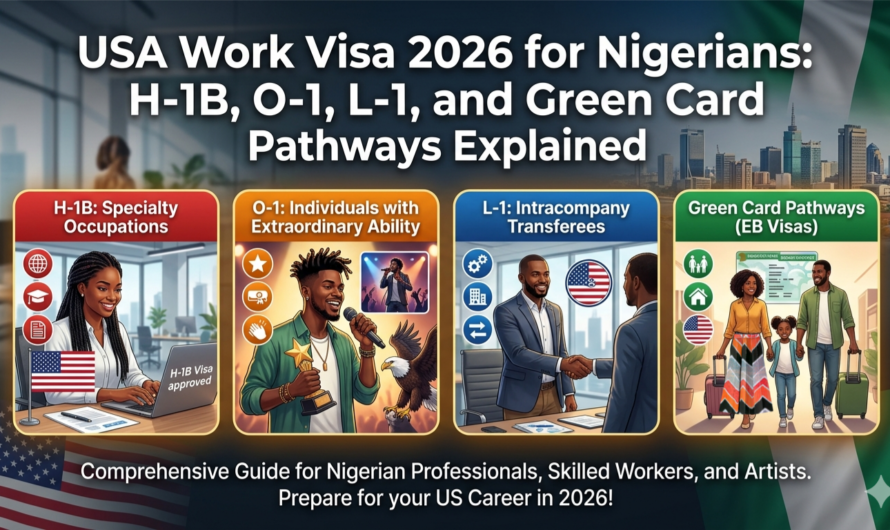
  • USA Work Visa 2026 for Nigerians: H-1B, O-1, L-1, and Green Card Pathways Explained

    The USA work visa 2026 options for Nigerian professionals remain some of the most lucrative in the world, despite the well-known complexity of the American immigration system. With H-1B visa holders in tech earning average salaries above $120,000 per year, O-1 visas available for those with extraordinary talent, and multiple employment-based green card pathways, the United States continues to attract Nigeria’s most ambitious professionals. This comprehensive guide covers every major USA work visa category relevant to Nigerians in 2026, the application process, realistic timelines, and strategies to improve your chances of success.

    Overview of USA Work Visa Categories for Nigerians

    Unlike points-based systems (Canada, Australia), the US immigration system is primarily employer-driven. Your US employer must petition for your visa on your behalf, and in most categories, there is no way to apply without a US job offer. Here are the main work visa categories relevant to Nigerian professionals:

    1. H-1B Visa (Specialty Occupations)

    The H-1B is the most well-known US work visa and is specifically for workers in specialty occupations — roles that require a minimum of a US bachelor’s degree or equivalent in a specific field. IT, engineering, finance, accounting, architecture, and healthcare are among the most common H-1B occupations.

    The H-1B has an annual statutory cap of 85,000 visas (65,000 regular cap + 20,000 for US master’s degree holders). Because demand exceeds supply, USCIS conducts an annual lottery in March each year. In 2025, approximately 470,000 registrations were received for 85,000 available visas — giving each registrant roughly an 18% chance of selection. Employers may register up to March each year, with selected applicants eligible to start work from October 1 of that year.

    2. O-1 Visa (Extraordinary Ability)

    The O-1 visa is available to individuals who demonstrate extraordinary ability in their field — defined as being in the top percentile of their profession nationally or internationally. Unlike the H-1B, there is no annual cap on O-1 visas, making it an excellent alternative for Nigerian professionals who can demonstrate exceptional achievement. Evidence of O-1 eligibility includes: major awards, publications in respected journals, high salary relative to peers, critical roles in distinguished organisations, media coverage, and professional memberships. The O-1 is increasingly used by Nigerian tech entrepreneurs, academics, artists, and senior executives.

    3. L-1 Visa (Intracompany Transferee)

    The L-1 visa allows multinational companies to transfer employees from a foreign office to a US office. If you work for a company that has operations in both Nigeria and the US, you may be eligible to transfer to the US on an L-1A (managers/executives) or L-1B (specialised knowledge) visa. There is no lottery for the L-1, and it can lead directly to an employment-based green card (EB-1C). This is one of the most reliable pathways to the US for Nigerian professionals already working for multinational corporations.

    4. TN Visa (USMCA — For Citizens of Canada and Mexico)

    Note: The TN visa is not available to Nigerian nationals, as it is exclusively for citizens of Canada and Mexico under the USMCA agreement. Mentioning this avoids confusion for Nigerians who may have encountered misinformation online.

    5. Employment-Based Green Cards (EB-1, EB-2, EB-3)

    Employment-based immigrant visas (green cards) are the ultimate goal for most Nigerians seeking permanent US residency. The three main categories relevant to Nigerian professionals are:

    • EB-1: For individuals with extraordinary ability, outstanding professors/researchers, or multinational executives. No employer sponsorship required for EB-1A (extraordinary ability).
    • EB-2: For professionals with advanced degrees or exceptional ability, including a National Interest Waiver (NIW) subcategory that allows self-petitioning without employer sponsorship
    • EB-3: For skilled workers with at least 2 years of experience or training, professionals with a US bachelor’s degree, and unskilled workers

    Nigeria unfortunately faces significant green card backlogs due to per-country limits — the wait time for Nigerian nationals in the EB-2 and EB-3 categories is currently estimated at 5 to 10+ years due to high demand from a country of Nigeria’s size. The EB-1A and EB-2 NIW categories have shorter wait times and no employer sponsorship requirement, making them attractive for highly qualified Nigerian professionals.

    How to Improve Your Chances of H-1B Selection

    Since the H-1B is subject to a lottery, your best strategies for improving selection odds include:

    1. Pursue a US master’s degree: US master’s graduates receive a separate 20,000-visa cap, effectively giving two lottery entries and significantly increasing your odds
    2. Target cap-exempt employers: Universities, non-profit research organisations, and government entities are exempt from the H-1B cap — you can work for them without entering the lottery
    3. Consider O-1 as an alternative: If you have extraordinary qualifications, an O-1 petition can be approved year-round without a lottery
    4. Use L-1 as a strategic pathway: Joining the US office of your current multinational employer is sometimes the clearest path to the US, especially if the L-1 can later be converted to a green card
    5. Work for companies that file multiple H-1B petitions: Large tech companies (Google, Microsoft, Amazon, Meta) file thousands of H-1B registrations each year and have dedicated immigration teams to manage the process

    US Work Visa Salaries for Nigerian Professionals

    The financial case for working in the US is compelling for most Nigerian professionals:

    • Software Engineer (H-1B): Average $115,000–$180,000/year (FAANG companies often pay $200,000+)
    • Registered Nurse (H-1B): Average $70,000–$100,000/year
    • Civil Engineer: Average $80,000–$120,000/year
    • Financial Analyst: Average $70,000–$110,000/year
    • Doctor (J-1/H-1B): Average $200,000–$400,000/year depending on specialty

    USA Work Visa 2026: Frequently Asked Questions

    Can I apply for a US work visa without a job offer?

    For most US work visa categories, a US employer must petition on your behalf — so a job offer is required. The main exceptions are the EB-1A (extraordinary ability) green card and the EB-2 National Interest Waiver (NIW), which allow self-petition. The O-1 visa requires an employer or agent sponsor but not a traditional employer-employee relationship.

    Is the H-1B lottery really random?

    Yes. USCIS uses a computer-generated random selection process. All regular cap petitions compete in one lottery pool, and US advanced degree holders compete in a separate pool first. Each registered worker has one chance in the regular pool (or two chances if they have a US master’s). In 2025, individual odds were approximately 18% — meaning 82% of registrants received no invitation despite having a valid job offer.

    How can I move to the US without winning the H-1B lottery?

    Several alternatives exist: the O-1 visa (no cap), L-1 visa (intracompany transfer, no cap), EB-2 NIW (self-petition green card for those of exceptional ability), or working for a cap-exempt employer. Some Nigerians also transition to the US via Canada — spending a few years in Canada as PR holders before applying for a US visa with stronger credentials and experience.

    Take the Right Steps Toward the United States

    Pursuing the USA work visa 2026 as a Nigerian requires strategic planning, patience, and the right employer partnership. While the H-1B lottery creates uncertainty, alternative pathways like the O-1, L-1, and EB-2 NIW offer viable routes for qualified professionals.

    While you pursue your US strategy, consider building international experience through remote work — see our guide on remote jobs abroad for Nigerians in 2026. Also read our broader overview of the best countries to work abroad as a Nigerian in 2026, and ensure your application is world-class with our guide on how to get a job abroad with visa sponsorship.

    EB-2 National Interest Waiver (NIW): The Self-Petition Route to a US Green Card

    The EB-2 National Interest Waiver is a particularly important pathway for highly qualified Nigerian professionals because it allows you to petition for a US green card without an employer sponsor. To qualify, you must demonstrate that your work is in the national interest of the United States — meaning your proposed work has substantial merit, you are well-positioned to advance that work, and the benefits of waiving the normal job offer and labour certification requirements outweigh the national interest in having US workers fill the position. In practice, the NIW is heavily used by researchers, scientists, engineers, doctors, educators, and other knowledge workers who can demonstrate the importance of their work through publications, citations, patents, awards, or quantifiable contributions to their field. Nigerian academics, medical researchers, engineers with patented innovations, and public health professionals have increasingly used the NIW pathway with success. Unlike the EB-3, which requires employer sponsorship and a lengthy PERM labour certification process, the NIW self-petition can be filed at any time without waiting for an employer. Current EB-2 NIW processing times for Nigerian nationals are approximately 12–24 months for the I-140 petition, after which you wait in the visa queue based on your priority date. For Nigerian professionals with the right credentials and a compelling case, the NIW is worth serious consideration as a direct, employer-independent route to US permanent residency.

    For those pursuing US opportunities, building your profile through remote work with American companies (read our remote jobs abroad guide) while simultaneously pursuing an NIW petition is an increasingly popular two-track strategy. Explore all your international options in our guide to the best countries to work abroad as a Nigerian in 2026.

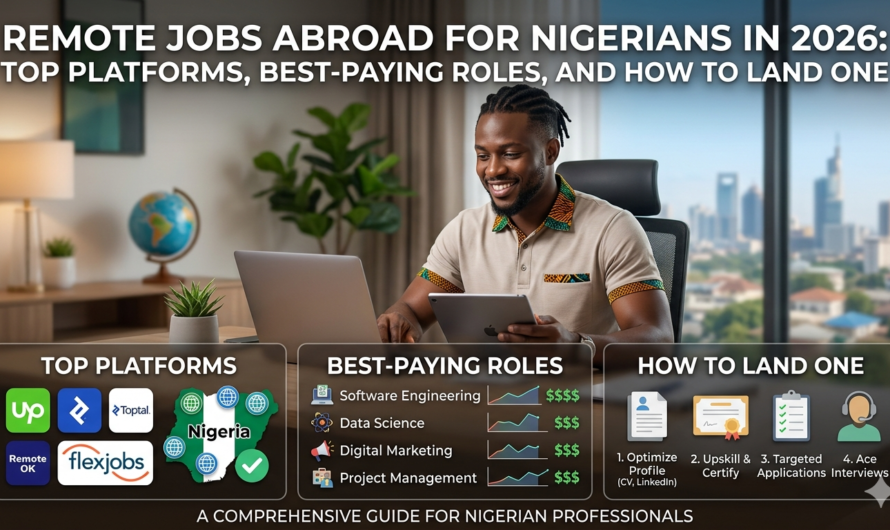
  • Remote Jobs Abroad for Nigerians in 2026: Top Platforms, Best-Paying Roles, and How to Land One

    Remote jobs abroad for Nigerians have expanded dramatically in 2026, with thousands of international companies actively hiring Nigerian professionals for fully remote or hybrid roles that pay in US dollars, British pounds, euros, and Canadian dollars — without requiring relocation. For Nigerians who want to earn at international salary levels while remaining in Nigeria or who wish to transition gradually to living abroad, remote work represents one of the most powerful career opportunities of our time. This guide covers the top platforms, best-paying remote roles, and the strategies Nigerian professionals use to land high-paying international remote jobs in 2026.

    Why Remote Jobs Abroad Are a Game-Changer for Nigerians in 2026

    The global shift to remote work — accelerated by the COVID-19 pandemic and now permanently embedded in many company cultures — has fundamentally changed the Nigerian professional’s relationship with the global job market. A software engineer in Lagos can now earn a US salary while paying Nigerian living costs. A content strategist in Abuja can serve clients in London, Toronto, and Sydney without a visa or relocation.

    Key advantages for Nigerian remote workers include:

    • Dollar/pound earnings: Earnings in hard currencies provide significant income advantages given the naira exchange rate
    • No visa required: Work internationally without the cost, complexity, or wait times of visa applications
    • Competitive salaries: Entry-level remote tech roles for international companies pay $20,000–$50,000/year; senior roles $60,000–$150,000+
    • Career development: Working with international companies builds a global resume and opens doors to future visa-sponsored relocation opportunities
    • Flexibility: Work from anywhere in Nigeria or travel while working

    Top Remote Job Platforms for Nigerians in 2026

    1. Remote.co

    Remote.co is one of the most curated remote job boards, featuring hand-screened listings across software development, customer support, project management, writing, and marketing. All jobs are confirmed as 100% remote. Use the company page feature to research each employer’s remote work culture before applying.

    2. We Work Remotely

    With over 6 million monthly visitors, We Work Remotely (weworkremotely.com) is the largest remote work community online. Categories include programming, design, copywriting, management, finance, and executive roles. Many listings are from tech companies that explicitly hire globally, including candidates from Africa.

    3. Toptal

    Toptal connects the top 3% of global freelancers with leading companies. The vetting process is rigorous — only about 3% of applicants pass — but acceptance means access to high-paying projects ($50–$200+/hour) with top-tier companies. Toptal is particularly strong for software engineers, data scientists, and financial analysts.

    4. Andela

    Andela was founded specifically to connect African tech talent with global companies, making it one of the best platforms for Nigerian software developers, designers, and data professionals. Andela matches Nigerian developers with remote contracts at US and European companies, with pay rates of $20,000–$70,000+ per year. The platform also provides career support, skill development programmes, and a community of African tech talent.

    5. Deel

    Deel is a global HR platform that enables companies worldwide to hire and pay remote workers in over 150 countries, including Nigeria. Many international companies that use Deel to manage their workforce actively post remote roles. Deel also handles compliance, contracts, and local currency payroll, making it one of the most Nigeria-friendly platforms for remote employment.

    6. Upwork and Fiverr

    For freelancers and independent contractors, Upwork and Fiverr remain two of the largest global platforms. While competition is fierce, Nigerians with strong English skills and demonstrable expertise in writing, development, design, SEO, video editing, and customer support can build substantial incomes. Top Nigerian freelancers on Upwork earn $50,000–$100,000+ per year across multiple clients.

    Highest-Paying Remote Jobs for Nigerians in 2026

    • Software Engineer / Full-Stack Developer: $40,000–$130,000/year (mid-senior level)
    • Data Scientist / Machine Learning Engineer: $50,000–$140,000/year
    • Cybersecurity Analyst: $45,000–$110,000/year
    • Product Manager: $60,000–$130,000/year
    • UX/UI Designer: $35,000–$80,000/year
    • DevOps / Cloud Engineer: $55,000–$120,000/year
    • SEO / Digital Marketing Manager: $25,000–$70,000/year
    • Technical Writer: $30,000–$75,000/year
    • Financial Analyst / Accountant (remote): $35,000–$90,000/year
    • Virtual Assistant (Senior/Specialist): $20,000–$45,000/year

    How to Secure a Remote Job with an International Company

    Build a Strong Online Presence

    International remote employers cannot meet you in person, so your online presence is your first impression. Ensure your LinkedIn profile is comprehensive and regularly updated. Create a professional portfolio website showcasing your work, skills, and achievements. Contribute to open-source projects (for developers), publish thought leadership articles (for consultants), or build a portfolio of published work (for writers).

    Optimise for Time Zone Compatibility

    Nigeria is in the West Africa Time (WAT) zone, which is GMT+1. This means you overlap with European business hours almost entirely (CET/CEST is only 1–2 hours ahead) and have a partial overlap with US East Coast hours (5–6 hours behind). Many international remote employers prefer candidates who can work during European or US hours. Highlight your willingness to adjust working hours or show flexibility in your application.

    Address Infrastructure Challenges Proactively

    A common concern international employers have about Nigerian remote workers is reliability of internet and power supply. Address this proactively by investing in a backup internet connection (mobile data hotspot from a reliable network), an uninterruptible power supply (UPS) or inverter, and a professional, distraction-free workspace. Mentioning these provisions in your cover letter or interview demonstrates professionalism and builds employer confidence.

    Remote Jobs Abroad for Nigerians: Frequently Asked Questions

    Do I need to pay tax on income from remote international jobs while living in Nigeria?

    Yes. Income earned from foreign employers while living in Nigeria is subject to Nigerian personal income tax under the Personal Income Tax Act (PITA). You are liable to declare and pay tax on all income earned in Nigeria regardless of the source. However, foreign income not remitted to Nigeria is in a grey area; consult a Nigerian tax professional for guidance specific to your situation.

    How do I receive payments from international remote employers in Nigeria?

    Common payment methods used by Nigerians receiving international remote income include Payoneer (the most widely used), Wise (formerly TransferWise), Grey.co (a Nigerian fintech that gives you a US/EU virtual account), and direct wire transfers to a Nigerian domiciliary account. Avoid platforms that do not support Nigeria — PayPal has significant restrictions on receiving payments in Nigeria as of 2024.

    Can remote work experience help me get a visa-sponsored job abroad later?

    Absolutely. Remote experience with a reputable international company dramatically strengthens your profile for eventual visa-sponsored relocation. Employers in the UK, Canada, and Germany often prefer candidates who have already demonstrated the ability to work in international environments. Some remote employers also offer to sponsor employees to relocate to their country after a period of successful remote work.

    Start Earning Internationally Without Leaving Nigeria

    Remote jobs abroad for Nigerians in 2026 represent a fast track to international income, global experience, and a stronger career platform for eventual relocation. Whether you start on Andela, build a freelance portfolio on Upwork, or land a full-time remote role with a US tech company, the path is accessible, proven, and growing.

    Once you have built international experience remotely, consider your next step with our guides on the best countries to work abroad as a Nigerian in 2026 and how to get a job abroad with visa sponsorship. Also ensure you have a competitive CV ready for when you decide to relocate — read our guide on how to write a CV for international job applications.

    Setting Up Your Remote Work Infrastructure in Nigeria

    One of the most frequently asked questions from Nigerians starting remote work for international companies is: how do I ensure reliable enough infrastructure to maintain professional standards? This is a legitimate concern given the realities of power supply and internet connectivity in many parts of Nigeria. Here is a practical setup used by successful Nigerian remote workers:

    • Primary internet: Fibre broadband (MTN Fiber, Spectranet, Smile, or IHS Fiber where available) — minimum 20 Mbps upload/download for reliable video conferencing
    • Backup internet: A 4G LTE mobile hotspot (MTN, Airtel, or Glo) as a failover for outages
    • Power: A minimum of a 2kVA inverter with a 200Ah battery bank plus a 200W solar panel setup provides 6–12 hours of clean power for your devices and router during grid outages
    • Laptop: A reliable laptop with at least 16GB RAM and an SSD is necessary for most professional remote work; consider a second monitor for productivity
    • Noise-cancelling headset: Essential for video calls — the Jabra Evolve series and Plantronics Voyager series are popular with Nigerian remote professionals
    • Professional background: A clean, well-lit background with a ring light for video calls creates a professional impression for international employers and clients

    Investing in this infrastructure — total cost approximately ₦600,000–₦1,200,000 — pays for itself within 2–3 months of earning a dollar-denominated remote salary. It also signals to employers that you are serious, professional, and prepared for the rigours of international remote work. The most successful Nigerian remote workers treat their home office as a professional workspace and invest accordingly. Combined with strong communication skills and consistent delivery, this approach has enabled thousands of Nigerians to build international careers from their homes across Lagos, Abuja, Port Harcourt, and beyond.

    Remote work for international companies in 2026 is not just a trend for Nigerian professionals — it is a permanent structural shift in how global companies build their teams. By positioning yourself correctly today, investing in the right infrastructure, and building your international portfolio methodically, you can access income levels and career opportunities that simply were not available to Nigerians a decade ago. The future of work is borderless — and Nigerian professionals are increasingly at the forefront of it.

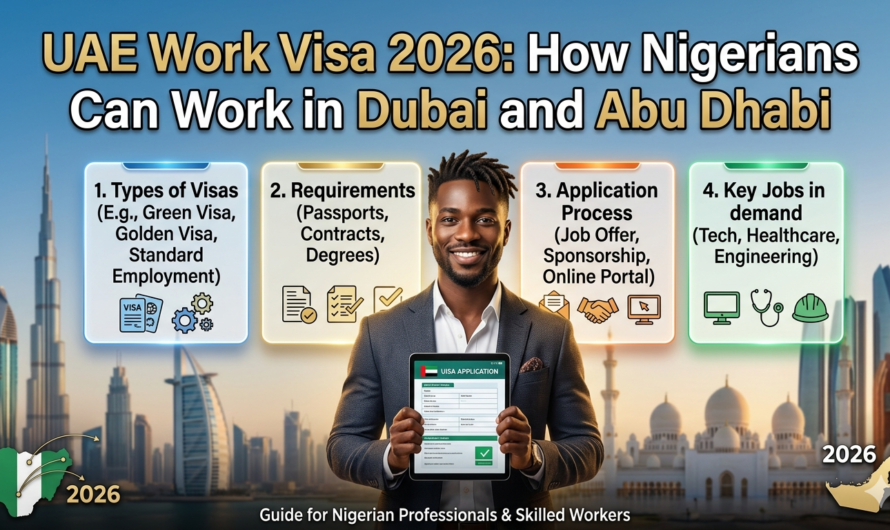
  • UAE Work Visa 2026: How Nigerians Can Work in Dubai and Abu Dhabi

    The UAE work visa 2026 is one of the most straightforward immigration pathways available to Nigerian professionals. The United Arab Emirates — and particularly Dubai — offers a unique combination of tax-free salaries, a world-class lifestyle, and a simple work permit process that depends entirely on securing a job offer rather than navigating complex points systems or language barriers. For Nigerians in banking, telecommunications, construction, IT, oil and gas, and hospitality, Dubai and the wider UAE represent one of the most accessible and financially rewarding destinations to work abroad in 2026.

    Why the UAE Is a Top Destination for Nigerian Professionals

    The UAE — comprising seven emirates including Dubai and Abu Dhabi — is home to over 200 nationalities and has one of the world’s most international workforces. Key attractions for Nigerians include:

    • Zero income tax: You keep 100% of your salary — no personal income tax on earnings
    • High salaries: Average professional salaries range from AED 10,000 to AED 50,000+ per month (approximately $2,700–$13,600)
    • Large Nigerian community: Thousands of Nigerians live and work in Dubai, with active community organisations and support networks
    • Strategic location: Dubai serves as a global business hub connecting Africa, Europe, and Asia
    • Modern infrastructure: World-class healthcare, housing, transport, and education
    • Simple work permit process: Your employer handles the work permit — no points test, no language certificate requirement for most roles

    Types of UAE Work Visas and Permits in 2026

    1. Employment Visa (Standard Work Permit)

    The standard UAE Employment Visa is the most common pathway for Nigerian workers. Here is how it works: your UAE employer obtains a work permit from the Ministry of Human Resources and Emiratisation (MOHRE), then arranges an entry permit for you. You travel to the UAE, undergo a medical examination, and receive your Emirates ID and residence visa. The initial visa is typically granted for 2 years and can be renewed as long as your employment continues.

    2. UAE Golden Visa (Long-term Residency)

    The UAE Golden Visa is a 10-year renewable residence visa available to investors, entrepreneurs, highly skilled professionals, outstanding students, and humanitarian pioneers. For professionals, eligibility requires employment in a specialised field and a minimum monthly salary of AED 30,000 (approximately $8,170). Golden Visa holders do not need an employer sponsor and can remain in the UAE even without an active employment contract, making it an exceptional option for Nigerian professionals at senior levels.

    3. UAE Freelance Visa / Self-Employment Permit

    Dubai’s various free zones — including Dubai Internet City, Dubai Media City, and Dubai Silicon Oasis — issue freelance permits that allow Nigerian professionals to operate as self-employed contractors without needing a UAE employer sponsor. Freelance permit fees start from approximately AED 7,500 per year (around $2,040) and are renewable annually. This is an excellent option for IT consultants, digital marketers, designers, and content creators.

    4. UAE Green Visa

    Introduced in 2022 and continuing in 2026, the UAE Green Visa offers a 5-year self-sponsored residency for skilled workers who earn a minimum monthly salary of AED 15,000 and hold a bachelor’s degree or equivalent. Unlike the standard employment visa, the Green Visa does not tie your residence status to a single employer, giving you the freedom to change jobs without losing your residency.

    In-Demand Jobs in Dubai and the UAE for Nigerians in 2026

    The UAE economy is diversifying rapidly beyond oil and gas, creating demand across many sectors where Nigerian professionals excel:

    • Banking and Finance: Dubai is home to over 60 international banks and hundreds of financial services firms. Nigerian finance professionals — particularly those with CFA, ACCA, or ICAN qualifications — are highly competitive. Salaries: AED 15,000–50,000/month
    • Information Technology: Dubai’s Smart City agenda and growing tech startup ecosystem create consistent demand for software engineers, data scientists, and cybersecurity experts. Salaries: AED 15,000–40,000/month
    • Oil and Gas: Abu Dhabi National Oil Company (ADNOC) and numerous international oil companies hire Nigerian engineers, geologists, and petrochemical professionals. Salaries: AED 20,000–60,000/month
    • Construction and Engineering: Dubai’s continuous infrastructure development requires civil, structural, and MEP engineers. Salaries: AED 12,000–35,000/month
    • Telecommunications: Etisalat (e&) and du recruit internationally for network engineering and management roles. Salaries: AED 15,000–45,000/month
    • Healthcare: Dubai Health Authority and private hospital groups recruit doctors and nurses. Salaries: AED 12,000–40,000/month

    How to Apply for a UAE Work Visa from Nigeria: Step by Step

    Step 1: Find a Job and Receive a Formal Offer

    Search for UAE roles on Bayt.com, Naukrigulf.com, GulfTalent.com, LinkedIn, and Indeed UAE. These are the most widely used platforms for UAE job searches. Tailor your CV to Middle Eastern standards — most UAE employers expect a CV with a professional photo and clear contact details. When you receive an offer, ensure it includes details about your salary, housing allowance, flights, and medical insurance.

    Step 2: Your Employer Applies for Your Work Permit

    Your UAE employer submits a work permit application to MOHRE on your behalf. Once approved, they receive an entry permit which allows you to enter the UAE for the purpose of taking up employment. This process typically takes 1 to 3 weeks.

    Step 3: Travel to the UAE and Complete Medical Tests

    Arrive in the UAE on the entry permit. Within the first weeks of arrival, you will undergo a mandatory medical fitness test (checking for tuberculosis and other communicable diseases) at an approved healthcare centre. You will also submit your passport and biometrics for your Emirates ID — a mandatory identification document for all UAE residents.

    Step 4: Receive Your Residence Visa and Emirates ID

    Once your medical clearance and ID application are processed, your residence visa will be stamped in your passport and your Emirates ID issued. Processing typically takes 2 to 4 weeks. Once complete, you are legally a UAE resident and can open a bank account, rent property, and sponsor your family.

    UAE Work Visa 2026: Frequently Asked Questions

    Can Nigerian nationals bring their families to the UAE on a work visa?

    Yes. Once you receive your UAE residence visa, you can sponsor your spouse and children to join you. To sponsor your family, you must earn a minimum monthly salary of AED 4,000 (or AED 3,000 with accommodation included). Children can be sponsored until age 18 (or 25 if studying full-time). The sponsorship process involves similar steps to your own visa and typically takes 2–4 weeks.

    Is there income tax in the UAE?

    The UAE does not levy personal income tax on salaries, which means your entire salary is take-home pay. A 5% Value Added Tax (VAT) was introduced in 2018 on goods and services, but wages are fully exempt. For Nigerian professionals used to paying PAYE (Pay As You Earn) tax in Nigeria or PAYE in the UK, this represents a significant financial advantage.

    What is the cost of living in Dubai for a Nigerian professional?

    Dubai’s cost of living is relatively high compared to Nigeria but manageable against typical professional salaries. Monthly costs for a single professional include rent (AED 4,000–10,000/month for a studio/one-bedroom), transport (AED 500–1,500/month), food (AED 1,000–2,500/month), and utilities. Many UAE employment packages include housing and transport allowances, which significantly reduce out-of-pocket costs.

    Make Your Move to the UAE in 2026

    The UAE work visa 2026 represents one of the fastest, most financially rewarding, and most accessible pathways for Nigerian professionals to work abroad. With no income tax, a straightforward employer-sponsored permit process, and one of the world’s most cosmopolitan work environments, Dubai and Abu Dhabi continue to attract thousands of skilled Nigerians every year.

    Start your search today on Bayt, GulfTalent, and LinkedIn, and read our broader guide on the best countries to work abroad as a Nigerian in 2026. Explore how to position yourself competitively with our guide on how to get a job abroad with visa sponsorship, and make sure your application materials are world-class with our guide on how to write a CV for international job applications.

    Cultural Adjustment: Living as a Nigerian in the UAE

    The UAE is an Islamic country with laws and customs that differ significantly from Nigeria, and understanding them is essential for any Nigerian planning to live and work there. Alcohol is legal and available in licensed venues such as hotels, bars, and clubs, but public intoxication is illegal and strictly penalised. Dress codes are enforced in public spaces — modest clothing covering shoulders and knees is required in malls, government buildings, and other public areas (the beach and hotel pools have different standards). Public displays of affection between couples are frowned upon and can result in legal consequences. Ramadan (which lasts approximately one month) requires that eating, drinking, and smoking be avoided in public during daylight hours — employees receive shorter working hours during this period by law. The UAE weekend is Saturday and Sunday in most private sector companies (changed from the traditional Friday-Saturday weekend in 2022), aligning the UAE more closely with global business schedules. The Nigerian community in Dubai is active and well-organised — the Nigerian Community in Dubai (NCD) and various state association chapters hold regular events and provide support to newly arrived Nigerians. Many Nigerian professionals report that the UAE offers exceptional earning potential, a safe environment, and a cosmopolitan lifestyle that makes cultural adjustment relatively smooth compared to other international destinations.

    The UAE work visa 2026 remains one of the most accessible and rewarding international career moves available to Nigerians. Begin your search on Gulf-specific job platforms today and explore our guides on the best strategies for landing a sponsored job abroad and writing a world-class international CV.

  • How to Get a Job Abroad with Visa Sponsorship in 2026: The Complete Guide for Nigerians

    Knowing how to get a job abroad with visa sponsorship is the most critical skill for any Nigerian professional planning to work internationally. With thousands of employers across the UK, Canada, Germany, Australia, and the UAE actively offering visa sponsorship for skilled workers, the opportunity is real — but so is the competition. In 2026, more Nigerian professionals than ever are successfully landing visa-sponsored roles by using the right strategies, platforms, and application techniques. This comprehensive guide covers everything from where to search for sponsored jobs to how to write the perfect application and negotiate your way to an international offer.

    What Does Visa Sponsorship Mean?

    Visa sponsorship occurs when an employer agrees to take responsibility for your work visa application in their country. The employer becomes your legal “sponsor” and vouches to the immigration authority that you are needed for a specific role, that you meet the required qualifications, and that the employer will be responsible for your immigration compliance during your employment.

    In practice, this means the employer applies for a work visa permit on your behalf (or gives you the required certificate/reference number to apply yourself), often covers or contributes to your visa application fees, and handles the administrative side of your immigration process. Not every employer offers sponsorship — many prefer to hire locally to avoid the cost and complexity. Finding employers who actively sponsor visas is therefore the foundation of your international job search.

    Top Job Platforms for Finding Visa-Sponsored Roles in 2026

    1. LinkedIn

    LinkedIn remains the single most powerful platform for international job searches. Use the advanced filters to search by country, job type, and experience level. In the search bar, type your job title alongside terms like “visa sponsorship available”, “relocation assistance”, or “open to international applicants”. Recruiters on LinkedIn frequently post roles with sponsorship and actively message candidates. Ensure your profile is 100% complete with a professional photo, detailed work history, and skills endorsements.

    2. Indeed

    Indeed aggregates millions of job listings and allows you to filter by location and keywords. Search for “visa sponsorship” or “work permit” alongside your job title and target country. Indeed’s “Apply with Indeed” feature simplifies the application process and allows you to track applications from one dashboard.

    3. UK Register of Licensed Sponsors

    The UK government maintains a public Register of Licensed Sponsors — a searchable database of every UK employer authorised to sponsor overseas workers on a Skilled Worker Visa. You can filter by industry, location, and employer name. Once you identify companies on this register in your field, research them on LinkedIn and apply directly, mentioning your awareness of their sponsorship licence. This approach dramatically increases your success rate compared to random applications.

    4. Make it in Germany (arbeitsagentur.de)

    Germany’s official skilled worker immigration portal — make-it-in-germany.com — lists thousands of jobs open to international applicants, along with visa and recognition guides tailored to each profession. The German Federal Employment Agency (Bundesagentur für Arbeit) also operates a job board at arbeitsagentur.de specifically for skilled workers from outside the EU.

    5. Canada Job Bank

    The Government of Canada operates the Job Bank (jobbank.gc.ca), which allows employers to post roles open to international workers. Many Canadian employers use this platform to find candidates for Labour Market Impact Assessment (LMIA)-approved roles — a mandatory step for many employer-sponsored Canadian work permits.

    6. Sector-Specific Portals

    For healthcare professionals, NHS Jobs (UK), Health Match (Australia), and Hays Healthcare (multiple countries) post roles with international recruitment actively ongoing. For IT professionals, Hired.com, Stack Overflow Jobs, and AngelList feature international roles with sponsorship. For engineers, Engineering Jobs and country-specific chambers of commerce often have targeted listings.

    How to Write a Winning Application for a Visa-Sponsored Role

    Tailor Your CV to the Target Country

    A single CV will not work across all target countries. UK CVs are typically 2 pages, use reverse-chronological order, and omit photos. German CVs (Lebensläufe) are often 1–2 pages, must include a professional photo, and follow a strict chronological format. Australian CVs can be 3–5 pages and are more detailed. American résumés are concise (1–2 pages maximum), with no personal information beyond contact details. Read our dedicated guide on how to write a CV for international job applications for country-specific templates.

    Address Visa Sponsorship Proactively in Your Cover Letter

    Many Nigerian applicants avoid mentioning their need for visa sponsorship, fearing it will disqualify them. The opposite approach is more effective: mention it early and frame it as a straightforward administrative process. For example: “I am a Nigerian national currently based in Lagos, and I would require a Skilled Worker Visa to take up this role. I am familiar with the process and ready to proceed immediately upon receiving an offer.” This transparency builds trust and saves time for both parties.

    Leverage Recruiters Who Specialise in International Placements

    International recruitment agencies specialise in placing overseas candidates into visa-sponsored roles. Examples include Hays International, Michael Page, Robert Half, and Adecco Global Staffing. In the Nigerian market, agencies like SIAO, Phillips Consulting, and SIMEDaR Consulting also facilitate international placements. Registering with these agencies puts you in front of employers who are already open to international hires.

    Countries with the Most Visa Sponsorship Opportunities for Nigerians in 2026

    Our research shows the following countries have the highest volume of visa-sponsored job postings for Nigerian professionals in 2026:

    1. United Kingdom: Over 150,000 active Skilled Worker Visa sponsorship licences across thousands of employers
    2. Canada: LMIA-approved jobs across healthcare, construction, IT, and agriculture
    3. Australia: TSS (Subclass 482) employer sponsors in healthcare, engineering, and IT
    4. Germany: Job Seeker Visa + direct employer sponsorship in IT, engineering, and healthcare
    5. UAE: Work permit arranged by employer — no visa lottery, just a job offer required

    For detailed visa guides for each country, see our articles on the UK Skilled Worker Visa 2026, Germany Skilled Worker Visa 2026, and Australia Work Visa 2026.

    How to Get a Job Abroad with Visa Sponsorship: Frequently Asked Questions

    Do I have to pay for my own visa sponsorship?

    In most cases, the employer covers the sponsorship costs (obtaining the licence and certificate of sponsorship), while the worker pays the government visa application fee. In the UK, the employer pays the Immigration Skills Charge (£239–£1,000 per year), while you pay the visa fee (£719+) and the Immigration Health Surcharge (£1,035/year). Beware of any company that asks you to pay for “sponsorship arrangements” — this is a common recruitment scam.

    How long does the visa sponsorship process take?

    Once you have a job offer and your employer assigns you a certificate of sponsorship (or equivalent), the visa application process typically takes 3 to 8 weeks in the UK, 4 to 12 weeks in Germany, and 2 to 6 weeks in the UAE. Canada’s employer-sponsored work permit (via LMIA) can take longer — 3 to 6 months — due to the Labour Market Impact Assessment process.

    Is it harder to get visa sponsorship for some jobs than others?

    Yes. Shortage occupations — those that the destination country cannot fill with local talent — are significantly easier to get sponsored for. Healthcare (nursing, medicine), IT (software development, cybersecurity), engineering, and skilled trades consistently appear on shortage occupation lists in the UK, Canada, Australia, and Germany. If your current occupation is not on any shortage list, consider upskilling in an adjacent area that is in demand.

    Your International Career Starts with the Right Strategy

    Learning how to get a job abroad with visa sponsorship is a skill that pays dividends for life. The Nigerian professionals who succeed internationally are not necessarily the most qualified — they are the most strategic, persistent, and well-prepared. Use the platforms, techniques, and country-specific guides on this site to build a focused, effective international job search campaign in 2026.

    Read our guide on the best countries to work abroad as a Nigerian in 2026 to choose your target destination, and explore our guide to remote jobs abroad for Nigerians if you want to build an international income without relocating immediately.

    Red Flags: Visa Sponsorship Scams Targeting Nigerians

    The demand for visa-sponsored jobs abroad has unfortunately created a thriving ecosystem of scammers targeting Nigerian job seekers. Understanding how these scams work is essential to protecting yourself. Common visa sponsorship scam patterns include: job offers emailed or WhatsApped out of the blue from unknown contacts; requests to pay “visa processing fees”, “document clearance charges”, or “insurance bonds” upfront; job descriptions that are vague or unrealistically well-paid for the stated role; employers who claim to be from reputable companies but use Gmail or Yahoo email addresses rather than corporate domains; and requests for your passport, NIN, or bank account details before any formal interview process. Legitimate foreign employers with visa sponsorship licences never ask you to pay any money before you start work. If a “job offer” requires you to pay any fee to a Nigerian agent or directly to a foreign employer before securing your visa, walk away — it is a scam. Always verify job offers by independently looking up the company on LinkedIn, their official website, and the relevant country’s register of licensed sponsors. Report suspicious offers to the Economic and Financial Crimes Commission (EFCC) or the relevant embassy. Our guide on the best countries to work abroad lists only legitimate, established pathways.

  • Australia Work Visa 2026: Top Pathways and How Nigerians Can Qualify

    The Australia work visa 2026 landscape offers some of the most competitive salaries and quality-of-life benefits available to Nigerian professionals anywhere in the world. With annual skilled worker salaries ranging from AUD $70,000 to $140,000 and beyond, Australia’s Skilled Migration Programme continues to attract thousands of international applicants each year. Whether you are a nurse, engineer, IT professional, or tradesperson, this guide covers every major Australia work visa pathway relevant to Nigerians in 2026, including how to apply, what scores you need, and what to expect on arrival.

    Why Australia Is an Excellent Choice for Nigerian Workers in 2026

    Australia combines high salaries with a relaxed lifestyle, world-class healthcare, and one of the most straightforward pathways to permanent residency for skilled migrants. The country’s immigration system is transparent and points-based, giving applicants a clear understanding of their eligibility. Key benefits include:

    • High minimum wage: Australia’s national minimum wage is AUD $23.23 per hour in 2026 — one of the highest in the world
    • Strong Nigerian community: An established diaspora community in Sydney, Melbourne, and Brisbane provides support networks
    • English-speaking environment: No language barrier for most Nigerians
    • Pathway to citizenship: After 4 years as a permanent resident (including at least 1 year as a citizen of a country with reciprocal arrangements or 5 years of PR), you can apply for Australian citizenship
    • Universal healthcare (Medicare): Permanent residents have access to Australia’s public healthcare system

    Main Australia Work Visa Pathways for Nigerians in 2026

    1. Skilled Independent Visa (Subclass 189)

    The Subclass 189 is Australia’s flagship points-tested skilled migration visa. It does not require a job offer, a state nomination, or sponsorship from a family member — you simply need to score high enough in the Points Test. To be invited, you typically need a minimum of 65 points, but recent invitation rounds have required scores of 80–90 points or higher for competitive occupations. The visa grants you and your family permanent residency in Australia immediately upon approval.

    2. Skilled Nominated Visa (Subclass 190)

    The Subclass 190 requires a nomination from an Australian state or territory government. In return for agreeing to live and work in that state for at least 2 years, you receive an additional 5 points added to your Points Test score. This makes the 190 visa more accessible than the 189 for applicants with scores slightly below competitive thresholds. Each Australian state and territory maintains its own occupation shortage list and may select occupations that are less competitive nationally.

    3. Employer Nomination Scheme (Subclass 186)

    The Subclass 186 visa requires sponsorship from an approved Australian employer and grants permanent residency directly. The Direct Entry stream is available for skilled workers nominated by employers for positions paying at least AUD $70,000 per year. The Temporary Residence Transition stream is available to those who have been working in Australia on a Temporary Skill Shortage (TSS, subclass 482) visa for at least 2–3 years.

    4. Temporary Skill Shortage Visa (Subclass 482)

    The TSS visa allows Nigerians with a job offer from a sponsoring Australian employer to live and work in Australia for up to 4 years (in the Medium-term stream) or 2 years (in the Short-term stream). It is the primary temporary work visa pathway and is commonly used as a stepping stone toward permanent residency via the Subclass 186. Minimum salary requirements apply and must be at least AUD $73,150 per year in 2026.

    How the Australia Points Test Works

    The Australian Points Test is the mechanism used to assess Skilled Independent (189) and Skilled Nominated (190) visa applicants. Points are awarded across several criteria:

    • Age: Maximum 30 points (for applicants aged 25–32)
    • English language ability: Up to 20 points (10 points for competent, 20 points for superior)
    • Skilled employment: Up to 20 points for overseas experience, up to 20 additional for Australian experience
    • Educational qualifications: Up to 20 points (doctorate: 20 pts, bachelor’s or higher: 15 pts)
    • Australian study requirement: 5 points
    • Specialist education: 10 points for a PhD from an Australian institution in a STEM field
    • Partner skills: Up to 10 points
    • State/territory nomination: 5 points (Subclass 190)

    A score of 65 points is the minimum to be eligible to submit an Expression of Interest (EOI). Scores of 80 or above are generally required for most competitive occupations in the Subclass 189 pool.

    In-Demand Occupations in Australia for Nigerian Professionals

    Australia’s Medium and Long-term Strategic Skills List (MLTSSL) and Short-term Skilled Occupation List (STSOL) identify the occupations eligible for skilled migration. In 2026, the most in-demand roles for Nigerian applicants include:

    • Registered Nurses: Average salary AUD $70,000–$95,000; strong demand nationwide
    • Software Engineers / IT Professionals: Average salary AUD $90,000–$140,000
    • Civil and Structural Engineers: Average salary AUD $85,000–$120,000
    • Accountants and Finance Professionals: Average salary AUD $75,000–$110,000
    • Medical Practitioners: GPs in rural areas can earn AUD $250,000+
    • Electricians and Plumbers: Average salary AUD $70,000–$90,000

    Step-by-Step Guide to Applying for an Australia Skilled Visa from Nigeria

    Step 1: Get Your Skills Assessed

    The first step is to have your qualifications assessed by the relevant Australian assessing body for your occupation. For example, Australian Computer Society (ACS) for IT, Engineers Australia for engineering, ANMAC for nursing. Assessment fees range from AUD $300 to $1,500 and timelines from 8 to 16 weeks.

    Step 2: Take an English Language Test

    IELTS Academic, TOEFL iBT, PTE Academic, and Cambridge C1 Advanced are all accepted. For maximum English points (20 pts), aim for IELTS 8.0 in all bands or equivalent “Superior” proficiency scores.

    Step 3: Submit an Expression of Interest (EOI)

    Submit your EOI through Australia’s SkillSelect online system. Your profile is then ranked by points score, and the Department of Home Affairs invites the highest-scoring candidates from each occupation to apply for a visa during regular invitation rounds.

    Step 4: Receive Invitation and Apply

    Upon receiving an invitation, you have 60 days to lodge your visa application with all supporting documents. Processing times for Subclass 189/190 applications average 12 to 24 months for Nigerian applicants. Ensure all documents (birth certificates, police clearances, health checks) are prepared in advance.

    Australia Work Visa 2026: Frequently Asked Questions

    Can I work in Australia while my skilled visa application is being processed?

    If you are already in Australia on a bridging visa (granted automatically when you lodge a visa application), you may be permitted to work, but this depends on your specific bridging visa conditions. If applying from Nigeria, you cannot work in Australia until your visa is granted.

    Is IELTS mandatory for an Australian work visa as a Nigerian?

    Yes, in most cases. An approved English language test is mandatory for most skilled migration visas. Nigeria is not exempt from the English language requirement, even though English is Nigeria’s official language. However, you may be exempt if you hold a passport from an English-speaking country (not applicable for Nigerian passport holders) or have completed a full degree taught in English from an Australian institution.

    How long does it take to become an Australian citizen from Nigeria?

    The typical pathway from Nigeria is: obtain a skilled visa (1–2 years) → receive permanent residency → live as a PR for 4 years → apply for citizenship. Total minimum timeline: approximately 5–7 years from initial application to citizenship. Australia allows dual citizenship, so you do not need to give up your Nigerian passport.

    Begin Your Australia Immigration Journey Today

    The Australia work visa 2026 remains one of the most competitive and rewarding immigration pathways available to skilled Nigerians. Whether you target the independent Subclass 189, secure state nomination via the 190, or find an employer sponsor through the 482/186 route, Australia offers exceptional salaries, quality of life, and a clear path to permanent residency and citizenship.

    For a broader comparison of international options, read our guide on the best countries to work abroad as a Nigerian in 2026. Learn how to position yourself effectively with our guide on how to find a job abroad with visa sponsorship. Also explore our guide to writing a CV for international applications to make sure your profile meets Australian employer standards.

    Life in Australia as a Nigerian Professional: What to Expect

    Beyond salaries and visa processes, it is important for Nigerian professionals to understand what daily life in Australia looks like before making the move. Australia has a vibrant and growing Nigerian community, with concentrations in Sydney, Melbourne, Brisbane, and Perth. Nigerian cultural organisations, churches, and community associations provide important social support during the settling-in period. Australia’s major cities are ethnically diverse and generally welcoming to African migrants, with relatively low levels of overt discrimination in professional environments. The Australian workplace culture differs from Nigeria’s in important ways: punctuality is strictly observed, hierarchy is less pronounced (you are expected to address your manager by first name), and direct communication is valued. Work-life balance is taken seriously — overtime is often compensated, and annual leave of 20 days per year (4 weeks) is statutory. Australia’s public school system is free for permanent residents’ children, and childcare subsidies are available. Healthcare through Medicare is comprehensive and covers most services at zero or minimal cost to permanent residents. The overall quality of life for Nigerian families in Australia is consistently rated as excellent by those who have made the move.

    The Australia work visa 2026 offers one of the clearest routes from Nigeria to a high-income, high-quality-of-life destination. Whether you choose the independent Subclass 189, secure state nomination, or find an employer sponsor, Australia rewards skilled migrants generously. See our broader guide on the best countries to work abroad for Nigerians in 2026 to confirm that Australia is the right fit for your career goals and lifestyle priorities.

  • Germany Skilled Worker Visa 2026: Complete Guide for Nigerian Professionals

    The Germany Skilled Worker Visa 2026 is one of the most attractive options for Nigerian professionals seeking to build a career in Europe. Germany is facing a critical shortage of skilled workers, with an estimated 2 million unfilled positions across various sectors. The country’s reformed Skilled Immigration Act (Fachkräfteeinwanderungsgesetz) has created multiple new pathways for qualified workers from Nigeria and other non-EU countries to live and work in Germany legally. This guide covers every visa option, eligibility requirement, salary expectation, and application step you need to know for 2026.

    Why Germany Is a Top Destination for Nigerian Workers in 2026

    Germany’s economy — the largest in Europe — continues to face a demographic crisis. An ageing population and low birth rate have created persistent labour shortages across nearly every industry. In response, Germany has actively expanded its immigration frameworks to welcome skilled workers from outside the EU.

    Key attractions for Nigerian workers include:

    • High salaries: Average monthly salaries range from €3,000 to €6,000+ depending on occupation and experience
    • Strong job security: German labour laws provide extensive worker protections
    • Pathway to permanent residency: After 4 years of legal residence, you can apply for a Permanent Settlement Permit (Niederlassungserlaubnis)
    • Free or low-cost education: Children of workers and workers themselves can access free or heavily subsidised university education
    • Healthcare and social security: Germany’s public healthcare system is among the best in the world
    • Gateway to the EU: German permanent residency gives you the right to live and work across the Schengen Area

    Germany Visa Options for Nigerian Skilled Workers in 2026

    1. Skilled Worker Visa (Fachkräftevisum)

    The standard Skilled Worker Visa is available to Nigerian nationals who have a recognised formal qualification (equivalent to a German vocational training qualification or university degree) and a concrete job offer in Germany. The role must match your qualification, and your salary must meet minimum wage requirements. Processing times vary between 4 and 12 weeks depending on the German embassy in Abuja or Lagos and the German immigration authority (Ausländerbehörde) in your destination city.

    2. EU Blue Card

    The EU Blue Card is the premium route for highly qualified professionals. It requires a recognised university degree and a job offer with a minimum annual salary of €45,300 in 2026 (or €40,770 for shortage occupations such as IT, engineering, and medicine). The EU Blue Card offers a faster pathway to permanent residency — just 21 months for those who demonstrate sufficient integration, compared to 4 years for the standard route.

    3. Job Seeker Visa

    A significant advantage Germany offers over most other destinations is the Job Seeker Visa, which allows qualified Nigerians to travel to Germany for up to 6 months to look for work without needing a job offer in advance. To qualify, you need a recognised degree, sufficient funds to support yourself during your stay (typically €5,000–€8,000), and health insurance. Once you find a job, you can apply to convert your Job Seeker Visa into a Skilled Worker Visa or EU Blue Card within Germany.

    4. Recognition Partnership Visa

    A new addition under the reformed Skilled Immigration Act, the Recognition Partnership allows Nigerians whose qualifications have not yet been formally recognised in Germany to enter the country and undertake a recognition process while already employed. This is particularly valuable for healthcare professionals — including nurses and doctors — whose Nigerian qualifications may require a German equivalency assessment that can take months to complete.

    How to Get Your Nigerian Qualifications Recognised in Germany

    Qualification recognition is often the most challenging step for Nigerian applicants. Germany’s recognition system depends on the profession and the federal state. Here is a simplified process:

    1. Use the Recognition in Germany (Anabin) database to check whether your specific Nigerian institution and degree are already evaluated
    2. Submit your qualifications to the relevant authority — this could be a German chamber of commerce (IHK), a professional body, or a state authority depending on your field
    3. Have your documents officially translated into German by a certified translator and apostilled by the Nigerian authorities
    4. For regulated professions (doctors, nurses, engineers, teachers), obtain a professional licence from the relevant German authority in your destination state

    The entire recognition process can take between 3 months and 2 years depending on the profession and completeness of your documentation. Starting early is essential.

    In-Demand Jobs in Germany for Nigerians in 2026

    The following sectors are experiencing the most acute shortages in Germany and are actively recruiting internationally:

    • Healthcare: Nurses (Gesundheits- und Krankenpfleger), doctors, physiotherapists — salaries range from €2,800 to €6,000+ per month
    • IT and Technology: Software developers, IT architects, cybersecurity specialists — salaries from €4,000 to €8,000 per month
    • Engineering: Mechanical, electrical, civil, and automotive engineers — salaries from €3,500 to €7,000 per month
    • Trades: Electricians, plumbers, HVAC technicians, welders — salaries from €2,500 to €4,500 per month
    • Logistics and Transport: HGV drivers, warehouse managers — salaries from €2,200 to €3,500 per month

    Germany Work Visa Application: Step-by-Step for Nigerians

    Step 1: Secure a Job Offer or Recognition Partnership Agreement

    Search for roles on German job platforms like Make it in Germany (arbeitsagentur.de), LinkedIn, XING, and sector-specific portals. Tailor your CV to German standards — a German CV (Lebenslauf) follows a distinct format that includes a professional photo, full personal details, and a chronological work history. Read our guide on how to write a CV for international job applications for tips on adapting your profile.

    Step 2: Apply at the German Embassy in Nigeria

    The German Embassy in Abuja and the German Consulate General in Lagos process visa applications for Nigerians. Book your appointment online well in advance — waiting times can be 2 to 6 months. Required documents typically include your job offer letter, qualification documents (certified and translated), passport, biometrics, motivation letter, and proof of finances.

    Step 3: Get Approval from the German Immigration Authority

    Before the embassy can issue your visa, the immigration authority (Ausländerbehörde) in your German destination city must approve the application. This process — which involves checking your qualification recognition and confirming your employment contract — adds additional weeks to the overall timeline.

    Germany Skilled Worker Visa: Frequently Asked Questions

    Do I need to speak German to work in Germany?

    For the IT sector, many German companies operate in English and do not require German language skills. However, for healthcare, education, and most other sectors, B2-level German proficiency is typically required for professional licensing and daily work. Investing in German language courses (A1–B2) before applying is strongly recommended and will significantly improve your job prospects.

    How long does it take to get a Germany Skilled Worker Visa from Nigeria?

    The complete process — from beginning qualification recognition to receiving your visa — typically takes 6 to 18 months. The main bottleneck is usually the qualification recognition process and the embassy appointment waiting time. Starting the recognition process early is the single most impactful step you can take to accelerate your timeline.

    Can I bring my family to Germany on a work visa?

    Yes. Your spouse and dependent children can accompany you to Germany. Your spouse is entitled to work without restriction once they obtain their own residence permit. Children under 18 have the right to attend school free of charge, and older children may access German universities with minimal or no tuition fees after a period of residency.

    Begin Your Germany Work Visa Journey Today

    The Germany Skilled Worker Visa 2026 represents a once-in-a-generation opportunity for Nigerian professionals. With 2 million vacancies, a welcoming immigration framework, and a clear pathway to permanent residency, Germany has made itself one of the most accessible European destinations for skilled Nigerians.

    Compare Germany with other top destinations in our comprehensive guide to the best countries to work abroad as a Nigerian in 2026. Also explore our guide on how to find jobs abroad with visa sponsorship and start researching employer opportunities in Germany today.

    Learning German: How Important Is It and How to Get Started

    Language is one of the most significant practical considerations for Nigerians planning to work in Germany. While English is increasingly spoken in German tech companies and multinational corporations, German language skills open far more doors — particularly in healthcare, manufacturing, trades, and public sector roles. The good news is that German language learning resources have never been more accessible or affordable. The Goethe Institut Nigeria operates branches in Lagos, Abuja, and Port Harcourt and offers certified German language courses from A1 (absolute beginner) to C2 (mastery). Online platforms including Deutsche Welle’s free courses (dw.com/germancourses), Duolingo, Babbel, and italki for one-on-one lessons with native German speakers offer flexible, self-paced learning. Most employers for healthcare and regulated professions require at least B2 level German, which typically takes 12–18 months of consistent study to achieve from scratch. Starting your German language journey 12–18 months before your planned visa application is one of the most impactful investments you can make in your Germany relocation strategy.

    The Germany Skilled Worker Visa 2026 is genuinely one of the most accessible pathways to Europe for qualified Nigerians — particularly those in healthcare, IT, and engineering. The combination of a Job Seeker Visa, a Recognition Partnership option, and a government actively promoting international recruitment makes Germany a standout destination. For a full comparison with other European and global options, read our guide on the best countries to work abroad as a Nigerian in 2026.

  • Canada Express Entry 2026: How Nigerians Can Get Invited at Lower CRS Scores

    The Canada Express Entry 2026 system has undergone some of the most significant changes in its history, creating new opportunities for Nigerian professionals to obtain Canadian permanent residency. In February 2026, Canada officially unveiled five new occupational categories with historically low Comprehensive Ranking System (CRS) cut-off scores — including a physician category that drew at just 169 points, the lowest in Express Entry history. This guide explains how the system works, how Nigerians can qualify, and which categories give you the best chances in 2026.

    What Is Canada Express Entry?

    Canada Express Entry is an online immigration management system that the Canadian government uses to select skilled worker applicants for permanent residency. The system manages three federal immigration programmes: the Federal Skilled Worker Programme (FSWP), the Federal Skilled Trades Programme (FSTP), and the Canadian Experience Class (CEC). Candidates create a profile, receive a Comprehensive Ranking System (CRS) score based on factors like age, education, language skills, and work experience, and the highest-scoring candidates receive Invitations to Apply (ITAs) for permanent residency through regular draws.

    The 5 New Express Entry Categories in 2026

    On February 18, 2026, Immigration, Refugees and Citizenship Canada (IRCC) officially announced five new occupational categories for targeted Express Entry draws. These category-based draws allow IRCC to issue ITAs specifically to candidates with experience in high-demand fields, regardless of their overall CRS score — meaning you can receive an invitation with a much lower score than a general draw would require.

    1. Physicians Category

    The physician category held its first-ever draw on February 19, 2026, issuing 391 ITAs at a CRS score of just 169 — over 300 points below the typical general Canadian Experience Class cut-off. To qualify, you need at least 12 months of full-time Canadian work experience as a physician within the past three years and a valid Express Entry profile with matching NOC codes. This is a transformational opportunity for Nigerian-trained doctors who have been working in Canada under temporary permits.

    2. Healthcare Workers Category

    Beyond physicians, a broader healthcare workers category covers nurses, pharmacists, physiotherapists, and other allied health professionals. Given Nigeria’s large pool of healthcare professionals working in Canadian hospitals and clinics under Temporary Foreign Worker permits, this category represents a direct pathway to permanent residency. CRS scores for healthcare draws have ranged from 430 to 470.

    3. STEM Occupations Category

    Science, Technology, Engineering, and Mathematics (STEM) occupations continue to be among the most in-demand in Canada. The STEM category draws have featured CRS scores in the range of 481 to 510. Software engineers, data analysts, cybersecurity specialists, and engineers from Nigeria with relevant Canadian or foreign work experience have strong prospects under this category.

    4. Skilled Trades Category

    Canada’s construction and trades sector faces chronic shortages. The Skilled Trades category targets electricians, plumbers, carpenters, welders, and heavy equipment operators. CRS scores for trades draws have been in the range of 350 to 440, significantly lower than general draws. Nigerians with trades certifications and experience working in Canada can particularly benefit.

    5. French Language Proficiency Category

    Draws targeting candidates with strong French language skills (CLB 7 or higher in French) have featured cut-off scores as low as 379. While French is not widely spoken in Nigeria, professionals who invest in French language training — particularly those targeting Quebec — can significantly boost their chances of receiving an ITA even with a lower overall CRS score.

    How to Calculate Your CRS Score

    Your CRS score is calculated based on four core factors, with a maximum of 1,200 points available. Here is a simplified breakdown:

    • Core Human Capital Factors (up to 500 points): Age, level of education, first official language proficiency (English or French), and Canadian work experience
    • Spouse or Common-Law Partner Factors (up to 40 points): Education level, language proficiency, and Canadian work experience of your partner
    • Skill Transferability Factors (up to 100 points): Combinations of education, foreign work experience, and language skills
    • Additional Points (up to 600 points): Provincial Nomination (+600 points), Canadian job offer (+50 or +200 points depending on NOC level), Canadian education, siblings in Canada, and French language proficiency

    For most Nigerian applicants without a Provincial Nomination or Canadian job offer, competitive general draw CRS scores are in the 490–540 range. Category-based draws offer significantly lower thresholds.

    Step-by-Step Guide to Applying Through Canada Express Entry 2026

    Step 1: Determine Your Eligibility

    For the Federal Skilled Worker Programme (the most accessible route for Nigerians applying from outside Canada), you need at least one year of continuous full-time skilled work experience (NOC TEER 0, 1, 2, or 3) in the past 10 years, a minimum CLB 7 in English or French in all four abilities (reading, writing, listening, speaking), and a post-secondary credential evaluated by a Designated Organisation (ECA).

    Step 2: Take Your Language Test

    IRCC accepts IELTS General Training or CELPIP for English, and TEF Canada or TCF Canada for French. Aim for at least CLB 9 (IELTS 7.0 in all bands) to maximise your CRS points. Language scores account for a significant portion of your CRS score.

    Step 3: Get an Education Credential Assessment (ECA)

    Your Nigerian degree or diploma must be assessed by a Designated Organisation — the most commonly used is World Education Services (WES). The ECA process typically takes 4–12 weeks and costs approximately CAD $260. WES is essential for claiming education points and establishing your eligibility.

    Step 4: Create Your Express Entry Profile

    Submit your profile through IRCC’s online portal. You will receive your CRS score immediately after completing your profile. If your score is competitive for a category-based draw, you may receive an ITA within weeks or months.

    Step 5: Receive an ITA and Submit Your PR Application

    If invited, you have 60 days to submit a complete permanent residency application with all supporting documents. Processing times for complete applications currently average 6 months from submission of the PR application. Upon approval, you receive Confirmation of Permanent Residence (COPR) and can land in Canada as a permanent resident.

    Canada Express Entry 2026: Frequently Asked Questions

    Do I need a job offer to apply through Express Entry?

    No. Unlike the UK or Germany, the Federal Skilled Worker Programme does not require a job offer. However, having a valid job offer from a Canadian employer in an eligible NOC adds 50 to 200 CRS points to your score, significantly improving your chances of receiving an ITA in a general draw.

    Can Nigerians in Nigeria (not yet in Canada) apply?

    Yes. The Federal Skilled Worker Programme is specifically designed for skilled workers applying from outside Canada. You do not need to have lived or worked in Canada before submitting your Express Entry profile. However, your language test and ECA must be from approved providers and must be current (within the validity period).

    How long does the Canada Express Entry process take from Nigeria?

    The overall timeline — from submitting your profile to landing in Canada as a permanent resident — typically takes between 12 and 18 months for most FSWP applicants. This includes time in the pool before receiving an ITA, 60 days to submit the PR application, and IRCC processing (approximately 6 months for complete applications).

    Take the First Step Toward Canadian Permanent Residency

    The Canada Express Entry 2026 system offers Nigerians more pathways than ever before, especially in healthcare, STEM, and trades. Whether you are already working in Canada or planning to apply from Nigeria, understanding your CRS score, optimising your profile, and targeting the right category-based draw can make the difference between waiting years and receiving an invitation within months.

    For a broader comparison of your international career options, read our guide on the best countries to work abroad as a Nigerian in 2026. Also learn how to present your qualifications effectively with our guide on how to write a CV for international job applications. Explore our resources on how to get a job abroad with visa sponsorship to maximise your chances of success.

    Provincial Nominee Programme (PNP): An Additional Pathway for Nigerians

    Beyond Express Entry, Canada’s Provincial Nominee Programme offers an alternative pathway to permanent residency for skilled workers who are willing to settle in a specific Canadian province or territory. Each of Canada’s 13 provinces and territories operates its own immigration streams, many of which have lower entry thresholds than the federal Express Entry system. For Nigerians, provinces like Ontario, British Columbia, Alberta, and Saskatchewan have streams specifically targeting workers in high-demand occupations including healthcare, technology, and skilled trades. A provincial nomination adds 600 CRS points to your Express Entry profile — effectively guaranteeing an ITA in the next available draw. Many PNP streams operate outside the federal pool entirely, meaning you can receive a provincial nomination and subsequent federal PR application approval without ever entering the Express Entry lottery. Research the specific streams available in your target province and ensure your occupation appears on their current in-demand occupation list before applying.

    The Canada Express Entry 2026 system, combined with the PNP pathway, means that qualified Nigerians in almost any skilled occupation have a viable route to Canadian permanent residency in 2026. The key is understanding which pathway suits your specific profile and targeting it strategically. Explore our guide to the best countries to work abroad for Nigerians in 2026 to compare Canada with other top destinations before committing to your pathway.